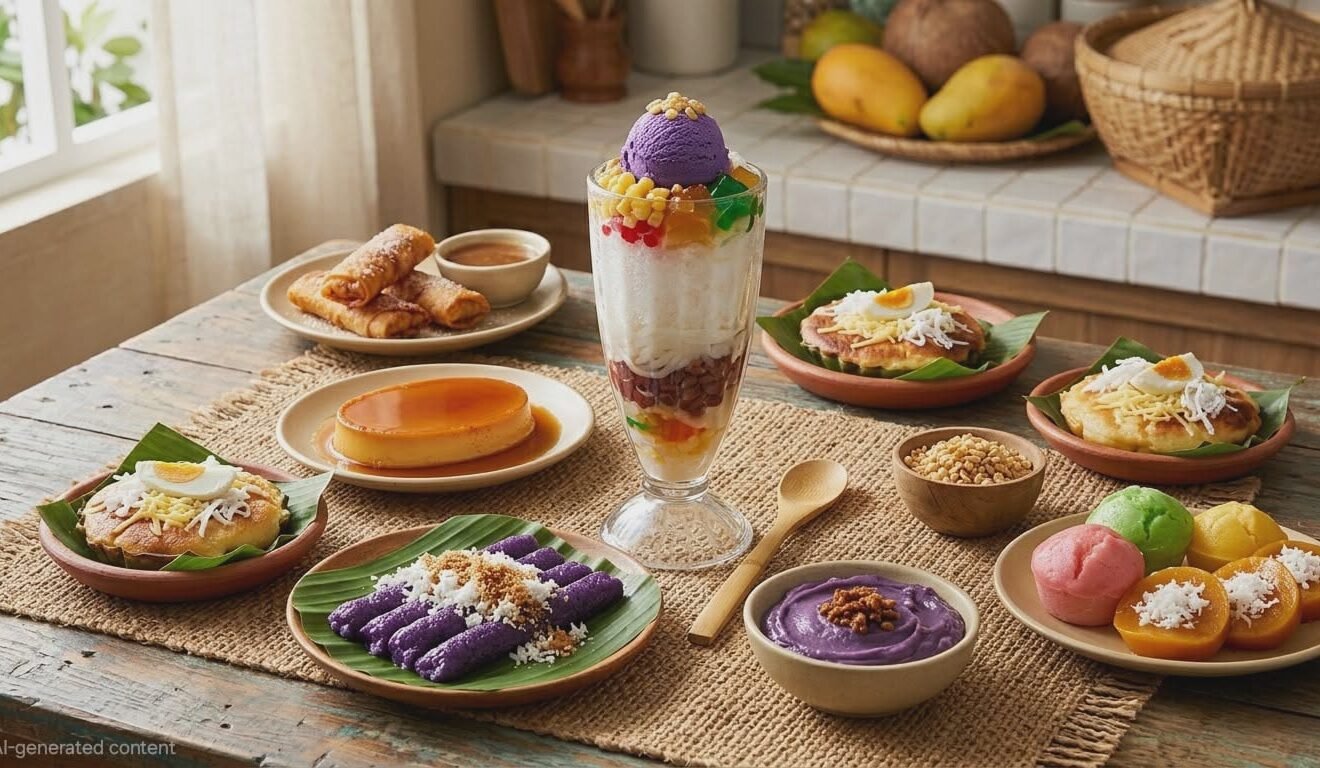
A Filipino party without dessert is not a Filipino party. Filipino desserts — and especially kakanin (rice-based sticky cakes) rooted in pre-colonial tradition — are fundamental to the language of celebration. Set alongside the richer Spanish-influenced desserts — leche flan, brazo de mercedes, sans rival — and you have one of the most diverse dessert cultures in Southeast Asia.
Why These Party Desserts Work
- Most scale beautifully — leche flan, sapin-sapin, and bibingka can all be made in large quantities.
- Many are make-ahead — leche flan, cassava cake, and biko all taste better after a day in the refrigerator.
- They are visually striking — kakanin have jewel-like colors and textures that are naturally beautiful on a table.
1. Leche Flan
The non-negotiable centerpiece. A dense, silky caramel custard made from egg yolks, condensed milk, and evaporated milk — steamed in a llanera mold, inverted to reveal a glossy caramel pool. Richer than crème brûlée, denser than regular flan.
Pro tip: Steam, never bake. Steaming produces the smoothest, most silken texture. Cover with foil during steaming to prevent condensation drips.
2. Bibingka
A soft rice flour cake cooked in banana-leaf-lined clay pots, topped with salted egg slices and grated coconut. The banana leaf gives it a slightly smoky, earthy aroma. The quintessential Filipino Christmas cake.
Pro tip: Serve warm — bibingka’s texture and aroma peak within 20 minutes of coming out of the oven.
3. Puto (Steamed Rice Cakes)
Soft, pillowy white steamed rice cakes — mildly sweet, slightly fermented — topped with cheese or salted egg. Individual portions, no slicing needed. Also pairs famously with dinuguan.
Pro tip: Do not over-mix the batter — overmixing produces tough, dense puto instead of the soft, springy texture you want.
4. Sapin-Sapin
A layered rice cake in three distinct colors — white (coconut), yellow (jackfruit), and purple (ube) — each layer chewy, mildly sweet, and fragrant. Topped with latik and served in diamond-cut wedges.
Pro tip: Each layer must be completely steamed and set before adding the next. Rush this and the layers bleed into each other.
5. Biko (Sticky Rice Cake)
Brown sugar sticky rice cooked in coconut milk until thick and glossy, topped with latik (caramelized coconut cream curds). Rich, chewy, deeply caramel-sweet. The most forgiving kakanin to make.
Pro tip: Cook the rice in coconut milk, not water. The rice should be very soft before adding sugar.
6. Maja Blanca
A delicate, snow-white coconut milk pudding set with cornstarch, topped with latik and sweet corn kernels. Cool, silky, gently sweet — the lightest dessert on this list.
Pro tip: Stir constantly while cooking — cornstarch-thickened mixtures seize and lump if left unattended for even 30 seconds.
7. Ube Halaya
Smooth, intensely purple ube (purple yam) cooked with coconut milk and condensed milk into a thick, fragrant jam. The flavor is unlike anything else — sweet, slightly earthy, unmistakably Filipino. Doubles as a spread, cake filling, or halo-halo topping.
Pro tip: Stir without stopping for the final 15–20 minutes as it thickens — it scorches if left alone. A non-stick pan makes this significantly easier.
8. Cassava Cake
Dense, moist cake from grated cassava, coconut milk, and condensed milk, baked with a caramelized top layer. Slightly chewy, coconutty, and easy to make in large quantities.
Pro tip: Squeeze the grated cassava in a clean cloth to remove excess liquid first — too much moisture produces a soggy, under-set cake.
9. Brazo de Mercedes
A Swiss-roll-style dessert of soft meringue (crisp outside, marshmallow-soft inside) wrapped around a rich egg yolk custard filling. Elegant, impressive, and completely delicious.
Pro tip: Spread the custard filling while both components are still warm for easier rolling without cracking.
10. Halo-Halo
A towering bowl of shaved ice over sweetened beans, jellies, nata de coco, banana, jackfruit, topped with leche flan, ube ice cream, and pinipig. Equal parts dessert and spectacle.
Pro tip: Set up a halo-halo station with individual components in separate bowls — people love customizing their own, and it is far more practical for a crowd than pre-assembling.
Tips for the Sweet Table
- Leche flan, biko, cassava cake, and ube halaya all taste better after 24 hours. Bibingka and puto are best made day-of and served warm. Make ahead strategically.
- Aim for a mix of silky (leche flan), chewy (biko), light (brazo), and refreshing (halo-halo). A table of all-heavy desserts exhausts guests. Vary textures.
- Simple name cards with a one-line description add hospitality and invite curiosity. Label everything.
Frequently Asked Questions

Jeff Smith
"Cooking is the intersection of history, science, and emotion."
For me, the kitchen has always been a laboratory of culture. With a background deeply rooted in digital strategy and precision, I approach the culinary arts with the same rigor I apply to the digital landscape—analyzing flavors, perfecting techniques, and documenting the nuance that makes Filipino cuisine truly world-class.
Findme Recipe was born from a desire to bridge the gap between traditional heritage and the modern home cook. Whether it is mastering the perfect balance of acidity in a classic Adobo or simplifying complex regional dishes for everyday kitchens, my mission is to preserve our culinary identity through accessible, data-backed, and delicious content.
I am not just building a database; I am cultivating a community where every Filipino kitchen feels empowered, every ingredient is celebrated, and every family heirloom recipe finds a place to thrive.
Join me as we translate the soul of our islands into recipes for the next generation.