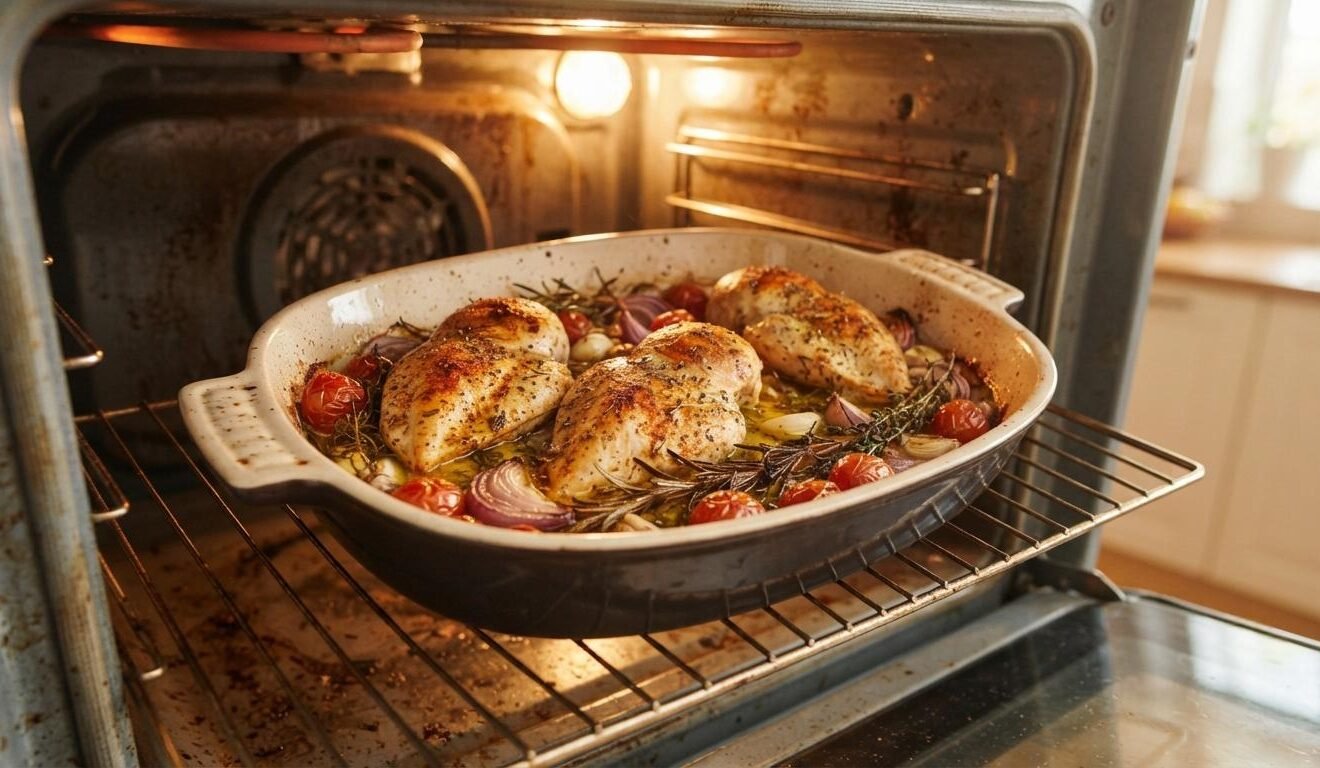
Chicken breast has a narrow window between “perfectly cooked” and “dry as cardboard,” which is probably why it’s one of the most Googled cooking questions out there. The honest answer is that it depends on your oven temperature and the thickness of the breast — but once you know those two things, getting it right becomes pretty reliable.
Why Thickness Matters More Than the Recipe Card Says
Chicken breasts sold at the grocery store vary a surprising amount in thickness, even within the same package. A recipe that says “bake for 25 minutes” is really giving you an estimate based on an average-sized breast, which is exactly why the same recipe can leave one person with perfectly juicy chicken and another with something dry and stringy.
This is why I stopped trusting exact minute counts years ago and just started checking with a thermometer instead — it’s the only thing that accounts for the chicken actually in front of you.
Cook Times by Oven Temperature
For a standard 6- to 8-ounce boneless, skinless chicken breast:
- 350°F: 25 to 30 minutes
- 375°F: 20 to 30 minutes
- 400°F: 18 to 25 minutes
- 425°F: 15 to 20 minutes
- 450°F: 12 to 18 minutes
Higher temperatures cook chicken breast faster and can give slightly better browning, but they also narrow the margin for error — a few extra minutes at 450°F does more damage than the same overage at 350°F.
Adjusting for Thickness
The times above assume a breast that’s roughly ¾ inch to 1 inch thick at its thickest point. For breasts thicker than that, add 5 to 8 minutes to the low end of the range. For thinner breasts, or ones pounded to an even thickness, subtract 5 to 8 minutes and start checking early.
The Internal Temperature That Actually Matters
Regardless of which oven temperature or time you use, chicken breast is done at 165°F internally, checked with an instant-read thermometer in the thickest part of the breast. Pull it at exactly that number rather than waiting for a higher reading — chicken continues cooking slightly from residual heat even after it’s out of the oven, a phenomenon called carryover cooking.
Should You Cover the Chicken While Baking?
Baking uncovered allows better browning and a slightly firmer exterior, while covering with foil traps steam and can help keep the chicken moister, especially at higher temperatures where drying out is more of a risk. Many cooks bake uncovered at moderate temperatures (350°F to 400°F) and reserve foil-covering for higher-heat methods or when reheating leftovers.
Tips for Consistently Juicy Chicken Breast
- Pound to an even thickness. This is the single biggest fix for uneven cooking — a breast that’s twice as thick on one end will always cook unevenly no matter how careful your timing is.
- Brine or season ahead of time. Even 15 minutes with a light salt coating helps the chicken retain moisture during baking.
- Don’t skip the rest. Let chicken rest for 5 minutes after baking before slicing, so the juices redistribute through the meat rather than spilling out onto the cutting board.
- Use a rimmed baking sheet with a wire rack if you have one — this lets air circulate underneath, cooking the breast more evenly than sitting flat in its own juices.
Quick Reference Chart
| Oven Temp | Cook Time (¾-1 inch breast) |
| 350°F | 25-30 min |
| 375°F | 20-30 min |
| 400°F | 18-25 min |
| 425°F | 15-20 min |
| 450°F | 12-18 min |
Common Mistakes That Lead to Dry Chicken Breast
Baking straight from the fridge, without letting the chicken sit out for 10 to 15 minutes first, is one of the more common culprits — the center stays colder and takes longer, which often means the outside overcooks while waiting for the middle to catch up. Skipping the thermometer and relying on visual cues like color is another common issue, since chicken can look done on the outside well before the center is safely cooked, or vice versa with an overcooked exterior masking an actually-done center. And cutting into chicken immediately after baking, rather than resting it, undoes a lot of the juiciness gained from careful timing.
Frequently Asked Questions

Jeff Smith
"Cooking is the intersection of history, science, and emotion."
For me, the kitchen has always been a laboratory of culture. With a background deeply rooted in digital strategy and precision, I approach the culinary arts with the same rigor I apply to the digital landscape—analyzing flavors, perfecting techniques, and documenting the nuance that makes Filipino cuisine truly world-class.
Findme Recipe was born from a desire to bridge the gap between traditional heritage and the modern home cook. Whether it is mastering the perfect balance of acidity in a classic Adobo or simplifying complex regional dishes for everyday kitchens, my mission is to preserve our culinary identity through accessible, data-backed, and delicious content.
I am not just building a database; I am cultivating a community where every Filipino kitchen feels empowered, every ingredient is celebrated, and every family heirloom recipe finds a place to thrive.
Join me as we translate the soul of our islands into recipes for the next generation.