
- The Intricate Deboning Process
Carefully begin by placing your whole chicken breast-side down on a clean, sturdy cutting board. Using a very sharp, flexible boning knife, make a precise incision along the entire length of the backbone. Gently peel the meat away from the rib cage, keeping the knife edge tight against the bone to minimize waste. Be exceptionally cautious when working around the wings and legs; you must disjoint them from the interior while keeping the exterior skin completely pristine and free of punctures. Once the entire carcass is removed, you should be left with a flat, boneless sheet of meat attached to the skin. Rub the interior with calamansi juice and soy sauce, then set it aside to marinate while preparing the stuffing.
- Mastering the Savory Meat Filling
In a large chilled mixing bowl, combine the ground pork, minced ham, and chopped Vienna sausages until the proteins are thoroughly integrated. Gradually fold in the sweet raisins, vibrant green peas, and finely minced carrots, which provide both texture and color contrast. Add the cubed cheddar cheese for pockets of creaminess, followed by the beaten eggs and breadcrumbs to act as the essential binding agents. Season the mixture generously with sea salt and freshly cracked black pepper. It is vital to mix the ingredients thoroughly but gently to avoid overworking the meat, which can result in a tough texture. Ensure the fats and lean meats are evenly distributed throughout the mixture to guarantee a moist and succulent final result.
- Strategic Layering and Proper Assembly
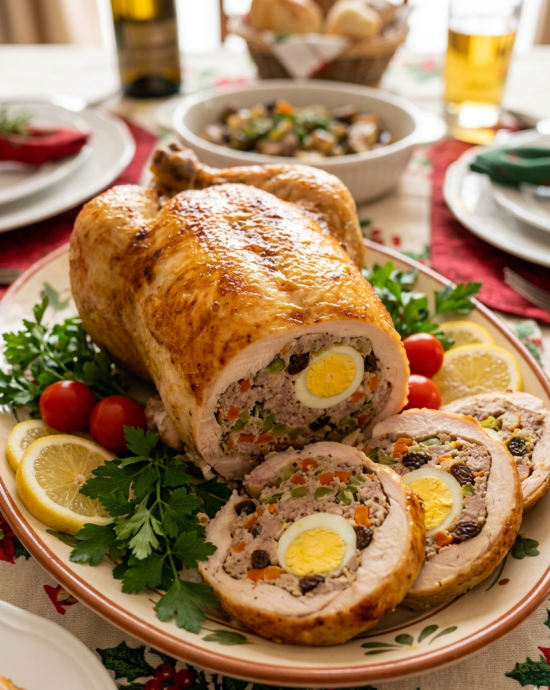
Spread the prepared chicken skin-side down on a large sheet of heavy-duty aluminum foil or cheesecloth. Carefully distribute half of the meat filling across the center of the chicken, smoothing it out to create an even base. Arrange the whole hard-boiled eggs and the sliced chorizo de bilbao in a single, neat line down the very center of the stuffing; these will create a beautiful mosaic pattern when the dish is eventually sliced. Cover the eggs and chorizo with the remaining half of the meat mixture, pressing down firmly to eliminate any hidden air pockets. This structural foundation is crucial for achieving a professional, uniform appearance that will impress guests once the galantina is presented on the serving platter.
- Securing the Roll for Steaming
Bring the two opposite sides of the chicken skin together over the filling, overlapping them slightly to ensure the meat is completely encased. Using a sturdy kitchen twine, tie the roll at two-inch intervals to maintain a cylindrical shape, or roll it tightly inside the aluminum foil, twisting the ends securely like a large candy wrapper. Double-wrap the entire assembly in another layer of foil to prevent any moisture from seeping inside during the cooking process. A tight wrap is the secret to a firm galantina that holds its shape during slicing. Place the prepared roll into a large steamer basket over boiling water. Cover tightly and steam for approximately ninety minutes, ensuring the internal temperature reaches the safe mark.
- The Final Chill and Presentation
Once the steaming process is complete, carefully remove the chicken roll from the heat and allow it to cool to room temperature on a wire rack. Do not attempt to unwrap or slice the galantina while it is still hot, as the fats and juices need time to redistribute and set properly. For the best results, refrigerate the wrapped roll overnight; this cold rest firms up the proteins and makes clean, thin slicing much easier. When ready to serve, remove the foil and twine, then glaze the skin with a light coating of oil or jelly for a professional sheen. Slice into rounds and serve cold or slightly at room temperature with a side of gravy or sweet pickles.
- Calories:370 kcal19%
- Energy:1,548 kj19%
- Protein:30 g60%
- Carbohydrates:14 g5%
- Sugar:5 g6%
- Salt:1.2 g20%
- Fat:20 g26%
Table of Contents
What Is Chicken Galantina?
Chicken galantina is a Filipino stuffed whole chicken filled with a savory mixture of ground pork, ground chicken, ham, Vienna sausages, hard-boiled eggs, raisins, and sweet pickle relish — rolled, wrapped, poached, and chilled until firm before being sliced into elegant, cross-sectioned rounds for festive occasions. The dish’s roots trace directly to the French culinary tradition of galantine — a classic preparation from classical European cuisine in which a whole bird is deboned, stuffed with a forcemeat filling, rolled tightly, and poached in a rich aspic. This technique arrived in the Philippines during the Spanish colonial period, traveling through the Hispanophone European culinary world before being transformed by Filipino cooks into something distinctly their own.
What makes the Filipino galantina unique among all galantine preparations worldwide is the specific combination of ingredients in the stuffing. The addition of raisins — which contribute a burst of unexpected sweetness among the savory ground meat — is a deeply Filipino touch, reflecting the local palate’s appreciation for sweet-savory contrasts in festive dishes. Sweet pickle relish adds a tangy, slightly sweet freshness, ham provides saltiness and visual appeal, and the halved hard-boiled eggs create the dramatic, decorative cross-section that makes every slice of galantina visually spectacular.
Galantina is quintessentially a dish for celebration — it appears on Christmas tables, birthday spreads, and town fiesta menus across the Philippines. Its preparation requires significant skill, time, and effort, which makes it a dish that communicates love, care, and respect for the people being fed. It is among the most technically ambitious recipes in the Filipino home cook’s repertoire and the one most likely to draw admiring gasps when brought to the table.
Ingredient Notes
- Whole Chicken (for Deboning): A medium whole chicken of 1.5 to 1.8 kg is ideal — large enough to contain a generous filling but not so large that it becomes unwieldy to debone and roll. Ask your butcher to debone it with the skin intact if you are not confident doing it yourself; this is a completely acceptable shortcut that many Filipino home cooks use for galantina.
- Ground Pork: Ground pork is the bulk of the stuffing and provides the essential fat content that keeps the filling moist and sliceable rather than dry and crumbly after chilling. Use a ground pork with at least 20% fat content — lean ground pork produces a dry, mealy stuffing that lacks the richness the dish requires.
- Vienna Sausages and Sweet Ham (Jamon Dulce): These cured, sweet-savory meats provide visual contrast, textural variety, and a nostalgic, Filipino-specific flavor in the stuffing cross-section. Look for pink, firm Vienna sausages and thinly sliced sweet ham; these two ingredients are visually as important as they are flavorful.
- Hard-Boiled Eggs: The eggs are the visual centerpiece of galantina’s cross-section — they must be perfectly cooked (no green ring around the yolk) and placed precisely at the center of the roll to ensure they appear symmetrically in every slice. Cook eggs for exactly 10 minutes in boiling water, then immediately transfer to an ice bath.
- Raisins: The characteristic Filipino touch in galantina stuffing — do not omit. Their sweetness provides an unexpected, delightful contrast to the savory ground meat that is one of galantina’s most distinctive flavor signatures. Use plump, moist raisins rather than dry, shriveled ones for the best texture and sweetness.
Ingredient Suggestions
- Sweet gherkins or olives — Sliced and arranged alongside the ham and Vienna sausages for additional visual decoration and a briny, tangy flavor note in each slice.
- Cheddar cheese strips — Laying strips of cheese alongside the ham creates a visually beautiful, melt-in-the-mouth element in the stuffing cross-section.
- Carrots (blanched strips) — Orange carrot strips arranged alongside the eggs add a vivid pop of color and mild sweetness to the decorative cross-section.
- Pineapple tidbits — A small amount folded into the ground meat mixture adds tropical sweetness that pairs beautifully with the ham and raisins.
- Chinese sausage (chorizo Macau) — Sliced and added to the filling instead of or alongside Vienna sausages; its sweet, anise-like flavor is a popular and delicious variation.
Helpful Tips & Pro Tips
- Have your butcher debone the chicken. If you are attempting galantina for the first time, there is absolutely no shame in asking a butcher to debone the chicken with skin intact. The stuffing, rolling, wrapping, and poaching are already demanding enough — removing the deboning challenge makes the dish significantly more approachable without compromising the final result.
- Chill under weight for a minimum of 4 hours. The pressing-and-chilling step is what transforms galantina from a rolled chicken into a firm, elegant, sliceable centerpiece. Cutting before full chilling produces crumbly slices that fall apart rather than holding their decorative cross-section shape. Overnight refrigeration produces the cleanest, most professional-looking slices.
- Why is my galantina falling apart when sliced? Galantina falls apart during slicing for two reasons: insufficient weight during cooling or cutting before fully chilled. Ensure the roll is weighted for at least 1 hour at room temperature and then at least 4 hours in the refrigerator. Use a sharp, thin-bladed knife and make clean, decisive slices rather than sawing.
- Use a thermometer for poaching. The difference between undercooked and properly cooked galantina is not always visible through the foil. A meat thermometer inserted through the foil wrap into the center of the roll is the most reliable way to confirm the filling has reached 74°C (165°F) throughout.
- Reserve the poaching liquid. The liquid in which the galantina poaches absorbs all the aromatics and chicken flavor, transforming into a beautifully flavored stock. Strain, degrease, and reduce it into a simple gravy to serve alongside the galantina — the pairing is extraordinary.
How to Serve and Store
Serve chicken galantina at room temperature or slightly chilled, sliced into even 1 to 1.5 cm rounds and arranged on a platter with the decorative cross-section facing upward. Garnish the platter generously with crisp lettuce leaves, sliced tomatoes, calamansi halves, and a drizzle of the reduced poaching liquid or a rich chicken gravy. For a festive presentation, pipe a few rosettes of mayonnaise or cream cheese along the edge of the platter.
Store leftover galantina tightly wrapped in plastic wrap or in an airtight container in the refrigerator for up to 4 days — the flavors continue to meld and improve after the first day. Galantina is excellent served cold and does not require reheating. For longer storage, wrap individual slices in plastic wrap and freeze for up to 2 months; thaw overnight in the refrigerator before serving.
Substitutions
- Ground pork → Ground turkey — A leaner substitute that still produces a flavorful stuffing; add 1 tbsp butter to compensate for reduced fat content.
- Vienna sausages → Cocktail franks or smoked chicken sausage — A readily available substitute with a similar mild, sweet sausage flavor.
- Sweet ham → Cooked luncheon meat — A budget-friendly alternative with a comparable salty-sweet flavor and visual appeal in the cross-section.
- Raisins → Dried cranberries — A tart, slightly sweeter substitute that provides the same sweet-savory contrast in the stuffing.
- Whole chicken → Boneless chicken thighs, laid flat and overlapping — A significantly simpler alternative for those who cannot or prefer not to debone a whole chicken; produces a flat roll rather than a round cylinder.
- Cheddar cheese → Queso de bola (Edam) — The traditional Filipino festive cheese, particularly appropriate for Christmas galantina preparations.
Suggested Recipes
- Embutido — The Filipino ground pork roll that uses a nearly identical stuffing philosophy to galantina but is simpler to prepare, making it an excellent practice recipe before attempting the full galantina.
- Chicken Relleno — A closely related Filipino stuffed chicken dish where the whole bird is stuffed rather than rolled, with the stuffing prepared slightly differently for oven roasting.
- Morcon — A Filipino beef roll stuffed with carrots, pickles, and hard-boiled eggs; shares galantina’s dramatic cross-section visual appeal and festive character.
- Chicken Pastel — Another labor-of-love Filipino celebration dish with similar savory filling ingredients, presented in pie form rather than as a rolled, sliced centerpiece.
Frequently Asked Questions

Jeff Smith
"Cooking is the intersection of history, science, and emotion."
For me, the kitchen has always been a laboratory of culture. With a background deeply rooted in digital strategy and precision, I approach the culinary arts with the same rigor I apply to the digital landscape—analyzing flavors, perfecting techniques, and documenting the nuance that makes Filipino cuisine truly world-class.
Findme Recipe was born from a desire to bridge the gap between traditional heritage and the modern home cook. Whether it is mastering the perfect balance of acidity in a classic Adobo or simplifying complex regional dishes for everyday kitchens, my mission is to preserve our culinary identity through accessible, data-backed, and delicious content.
I am not just building a database; I am cultivating a community where every Filipino kitchen feels empowered, every ingredient is celebrated, and every family heirloom recipe finds a place to thrive.
Join me as we translate the soul of our islands into recipes for the next generation.