

- Step 1: Prepare the Ingredients
Gather and prepare every ingredient before turning on the heat, as Pad Krapow Moo cooks in under seven minutes once the wok is hot and every second matters. Mince the garlic finely — Thai cooks often leave the garlic in slightly rough, uneven pieces for a more rustic texture rather than a fine, uniform paste. Roughly chop the bird's eye chilies, leaving the seeds intact for maximum heat. The seeds carry the majority of the capsaicin oil and are essential for authentic Pad Krapow spiciness. Carefully pluck the Holy Basil leaves from their stems and set aside in a bowl. Holy Basil — Krapow in Thai — has a distinctive clove-like, slightly peppery character fundamentally different from Italian basil or even Thai sweet basil. If Holy Basil is unavailable, the dish is technically a different recipe. Measure all sauce ingredients into a single small bowl and stir briefly to combine.
- Step 2: Heat the Wok
Place a wok or large, heavy skillet over the highest heat setting and leave it completely empty for a full two minutes. The wok must reach extreme temperature before any oil is added — this process is called seasoning the heat of the wok, and it creates the scorching surface temperature needed for wok hei, the subtle smoky caramelization that defines great Thai stir-fry. When a drop of water flicked into the wok evaporates within one second of contact, the surface has reached the correct temperature. Add the vegetable oil and swirl it around the entire interior surface. The oil should shimmer, ripple, and approach smoking within five seconds of contact with the hot pan — this is the correct temperature for stir-frying. Any lower temperature and the garlic will sweat rather than sear, losing the powerful, direct punch that makes Pad Krapow irresistibly bold and addictive.
- Step 3: Fry the Garlic and Chilies
Add the minced garlic and roughly chopped bird's eye chilies to the screaming hot oil simultaneously. Stir continuously for exactly twenty to thirty seconds. This step requires full attention and rapid movement — the garlic will pass from raw to fragrant to golden to burned in the span of a few seconds at this heat level. You are aiming for fragrant and beginning to color at the edges but absolutely not burned or brown. Burned garlic will make the entire dish bitter and acrid. The smell at this point should be intensely fragrant — the heat is liberating the volatile aromatic compounds from the garlic and the capsaicin oils from the chili simultaneously, creating the bold, sharp, penetrating fragrance that is the defining characteristic aroma of Pad Krapow Moo cooking in a Thai kitchen.
- Step 4: Cook the Minced Pork
Add the minced pork to the wok immediately after the garlic and chili are fragrant. Using a spatula or large spoon, break the pork apart aggressively into the smallest possible individual pieces — the goal is minced pork in its most literal sense, cooking as tiny individual fragments rather than clumps. Press the pork against the hot wok surface repeatedly to encourage contact browning. Cook, stirring and pressing, for three to four minutes until the pork is cooked through and beginning to show light golden-brown coloring in spots. Thai street versions of Pad Krapow often cook the pork until some pieces are almost crispy at the edges — this texture provides a satisfying contrast to the softer pieces. Drain any excess liquid that accumulates in the wok during cooking, as this prevents browning and dilutes the sauce.
- Step 5: Add the Sauce
Pour the pre-mixed sauce over the cooked pork and stir vigorously to coat every piece of meat evenly. The sauce should sizzle, sputter, and reduce rapidly against the hot wok surface — this is correct and desirable. Stir constantly for thirty to forty-five seconds as the sauce coats the pork and reduces slightly. The dark soy sauce should tint the pork a beautiful deep mahogany color while the oyster sauce creates a glossy, caramelized coating on the meat. Taste the pork at this point — the flavor should be intensely savory, slightly sweet, hot from the chilies, and salty from the fish sauce. If the sauce seems too salty, add a small pinch of sugar. The overall flavor should be bold and direct — Pad Krapow is not a subtle dish. Remove the wok from heat immediately before adding the basil in the next step.
- Step 6: Add Holy Basil
With the heat turned off, add the entire handful of Holy Basil leaves to the hot pork mixture and fold them in gently but quickly. The residual heat of the wok and the pork will wilt the basil leaves within five seconds without continuing to cook them further. This technique preserves the maximum essential oil content of the basil — particularly the eugenol compounds that give Holy Basil its characteristic clove-like, slightly anise, and peppery fragrance. If basil is added while the wok is still over heat, the volatile oils evaporate in seconds and the basil becomes merely green seasoning rather than the aromatic focal point of the entire dish. The wilted Holy Basil leaves should be glossy, deeply green, and intensely fragrant — their perfume should be the dominant smell rising from the finished pork.
- Step 7: Fry the Eggs and Serve
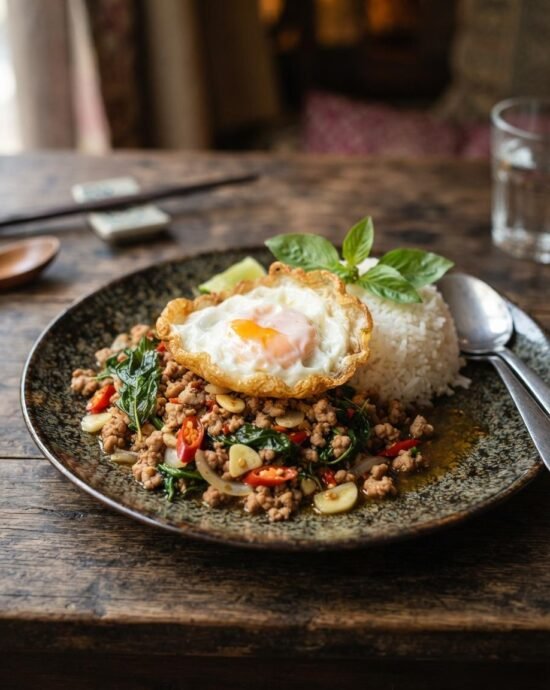
In a separate small pan, heat two centimeters of vegetable oil over high heat until shimmering. Crack each egg individually into the hot oil — the eggs should sizzle and bubble dramatically on contact. Fry each egg for approximately sixty seconds until the edges are brown and lacy-crispy while the yolk remains completely liquid and runny. This Thai-style fried egg — khai dao — with its impossibly crispy, golden lace edges and perfectly soft yolk is an absolutely non-negotiable element of an authentic Pad Krapow Moo service. Spoon steamed jasmine rice onto each individual plate, mound the pork basil stir-fry generously alongside, and crown the entire plate with a single perfectly fried egg. The yolk should be broken at the table and allowed to flow over the pork and rice, adding richness. Garnish with white pepper and serve immediately.
- Calories:420 kcal21%
- Protein:30 g60%
- Carbohydrates:6 g2%
- Sugar:3 g3%
- Fat:30 g38%
- Salt:2.2 g37%
- Energy:1,757 kj21%
Table of Contents
What Is Pad Krapow Moo?
Pad Krapow Moo is Thailand’s most popular, most ordered, and most beloved everyday street food dish — a fiercely simple, intensely flavored stir-fry of minced pork cooked with garlic, bird’s eye chilies, oyster sauce, and Holy Basil, served over steamed rice with a crispy-edged fried egg on top. The name describes the dish precisely: “pad” means to stir-fry, “krapow” is the Thai name for Holy Basil (Ocimum tenuiflorum), and “moo” is the Thai word for pork. The dish is so ubiquitous that ordering “Pad Krapow Moo Khai Dao” — with the addition of a fried egg — represents perhaps the single most commonly spoken food order in all of Thailand, found at every street cart, office canteen, and school cafeteria from Chiang Mai to Hat Yai. Pad Krapow Moo holds a special place in Thai culture that transcends mere food — it is the go-to comfort meal, the hangover cure, the late-night sustenance, and the easiest answer when nothing else sounds appealing. The dish’s appeal lies in its explosive simplicity: just five minutes of cooking time, a small number of readily available ingredients, and a result that is simultaneously bold, fragrant, savory, spicy, and deeply satisfying. The key is Holy Basil — a variety of basil (Ocimum tenuiflorum) with a distinct clove-like, peppery, slightly anise character unlike any other herb. When wilted into the hot pork at the final moment of cooking, it releases an aromatic complexity that is both the dish’s signature and its secret. No other basil variety produces the same result, and authentic Pad Krapow must be made with the genuine article to achieve its legendary status.
Ingredient Notes
- Holy Basil (Krapow): Holy Basil is the absolute, non-substitutable defining ingredient of this dish. Look for plants with distinctly serrated, slightly furry leaves and an immediately apparent clove-like fragrance when a leaf is crushed between the fingers.
- Minced Pork: Use pork with at least 20 percent fat content for the best Pad Krapow Moo — leaner pork dries out during the high-heat stir-fry and lacks the richness that makes the dish so satisfying. Freshly ground pork from the butcher is superior to pre-packaged.
- Bird’s Eye Chilies: Authentically spicy Pad Krapow Moo uses more chilies than most Western palates expect. Start with three and increase to five or seven for street food-level heat. Leave the seeds in for maximum impact.
Ingredient Suggestions
- Chicken (Pad Krapow Gai): Minced chicken is the second most popular protein for this dish and produces a lighter, slightly less rich version that is equally delicious and widely eaten across Thailand.
- Long Beans: Adding a handful of roughly chopped long beans provides textural contrast and a subtle earthy sweetness that complements the bold pork and basil combination.
- Extra Garlic: Doubling the garlic from four to eight cloves creates a more intensely aromatic version preferred by garlic lovers — many Thai street vendors use twice as much garlic as home cooks.
Helpful Tips & Pro Tips
- Use Holy Basil, not Thai sweet basil. This is non-negotiable. Thai sweet basil produces a completely different flavor — slightly anise and floral rather than the clove-peppery punch of Holy Basil. The dish’s name literally means Holy Basil stir-fry.
- Add Holy Basil off the heat. The volatile eugenol compounds responsible for Holy Basil’s clove-like fragrance evaporate almost instantly at high temperatures. Remove the wok from heat before adding basil every single time.
- Why does my Pad Krapow Moo taste bland? Insufficient chili or under-seasoned sauce are the most common causes. The dish should be aggressively seasoned — taste the sauce before cooking and make sure it is noticeably salty, sweet, and savory before adding to the pork.
- The fried egg is not optional. In Thailand, Pad Krapow Moo without the crispy fried egg is considered incomplete. The runny yolk functions as an additional sauce that enriches and mellows the intensely spiced pork, providing a crucial element of creamy richness.
How to Serve and Store
Pad Krapow Moo is best eaten immediately. Leftover pork stir-fry can be refrigerated in an airtight container for up to two days but loses the fragrance of the Holy Basil significantly. Reheat quickly in a hot wok or pan. The fried egg must be made fresh and cannot be stored — always fry eggs to order. The dish does not freeze well due to the basil and egg components.
Substitutions
- Minced Pork → Minced Chicken or Ground Turkey — lighter protein options that work very well in the dish.
- Holy Basil → Thai Sweet Basil (as last resort) — the flavor will differ significantly but provides the basil element if Holy Basil is completely unavailable.
- Fish Sauce → Soy Sauce — adequate salt replacement for a pescatarian-free version.
- Oyster Sauce → Mushroom Oyster Sauce — vegan-friendly alternative with comparable sweetness and umami depth.
- Bird’s Eye Chilies → Serrano or Jalapeño — milder heat for those who find bird’s eye chilies excessively spicy.
Suggested Recipes
- Khao Pad: Thai fried rice is often served as an alternative base for Pad Krapow Moo — spoon the basil pork over fried rice instead of steamed for a more substantial meal.
- Tom Yum Goong: Adding a bowl of Tom Yum alongside Pad Krapow Moo creates a complete, satisfying Thai meal with contrasting temperatures and flavor profiles.
- Som Tum: The bright, cooling acidity of Som Tum papaya salad provides perfect balance alongside the intense heat and richness of Pad Krapow Moo.
Frequently Asked Questions

Jeff Smith
"Cooking is the intersection of history, science, and emotion."
For me, the kitchen has always been a laboratory of culture. With a background deeply rooted in digital strategy and precision, I approach the culinary arts with the same rigor I apply to the digital landscape—analyzing flavors, perfecting techniques, and documenting the nuance that makes Filipino cuisine truly world-class.
Findme Recipe was born from a desire to bridge the gap between traditional heritage and the modern home cook. Whether it is mastering the perfect balance of acidity in a classic Adobo or simplifying complex regional dishes for everyday kitchens, my mission is to preserve our culinary identity through accessible, data-backed, and delicious content.
I am not just building a database; I am cultivating a community where every Filipino kitchen feels empowered, every ingredient is celebrated, and every family heirloom recipe finds a place to thrive.
Join me as we translate the soul of our islands into recipes for the next generation.