
- Step 1: Prepare and Season the Chicken
Rinse the whole chicken under cold running water and pat it completely dry inside and out with paper towels. Dry skin is essential for this recipe — any surface moisture will create steam inside the pot rather than allowing the chicken to cook in the dry, aromatic salt-heated environment that gives pinaupong manok its unique, concentrated flavor. In a small bowl, combine the fish sauce, calamansi juice, soy sauce, and ground black pepper and stir together until blended. Using your fingers, carefully loosen the skin from the breast and thigh meat without tearing it, and rub the seasoning mixture directly under the skin and inside the cavity. Allow the seasoned chicken to rest at room temperature for 15 minutes before cooking.
- Step 2: Stuff the Chicken Cavity
Stuff the chicken's cavity generously with the halved garlic head, thick slices of fresh ginger, spring onion stalks, bruised lemongrass, and bay leaves. Pack the aromatics in firmly so they fill the cavity completely — the enclosed space of the cavity concentrates the volatile essential oils of these aromatics during cooking, creating an internal perfume that seasons the chicken from the inside out throughout the entire cooking process. This inside-out aromatic infusion is the defining technique of pinaupong manok — the aromatics are not used in a sauce or braising liquid but instead perfume the chicken steam trapped inside the sealed cavity, gently flavoring every fiber of the meat from within. Truss the chicken loosely with kitchen twine to keep the cavity closed during cooking.
- Step 3: Prepare the Salt Bed
Pour the entire kilogram of rock salt or coarse sea salt into a large, heavy-bottomed pot or wok — one that is just wide enough to hold the whole chicken snugly upright. Spread the salt into an even, flat layer across the entire bottom of the pot, approximately 3 to 4 centimeters deep. The salt bed serves as both an insulating heat conductor and a flavor medium — as the chicken sits on the hot salt, it draws gentle, even heat upward through the bird while the mineral character of the rock salt subtly permeates the chicken skin. Heat the pot over medium heat for 5 minutes, stirring the salt occasionally until it feels very warm to a finger held just above (not touching) the surface. The salt should be hot but not smoking.
- Step 4: "Seat" the Chicken on the Salt
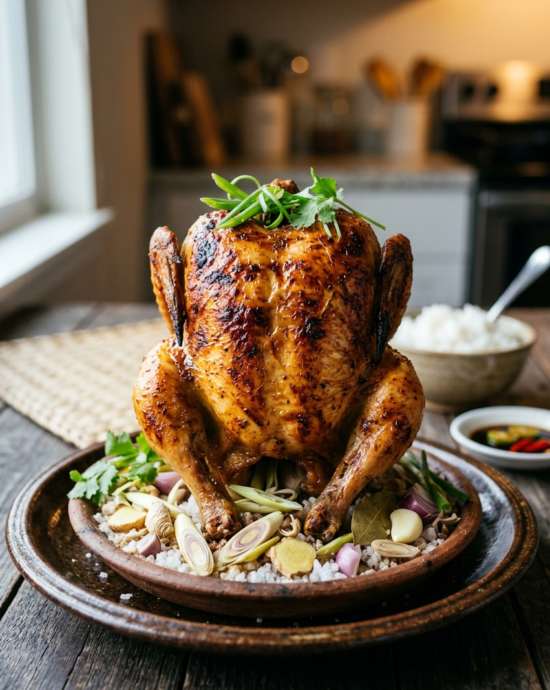
Carefully place the stuffed, seasoned whole chicken directly onto the hot salt bed, positioning it upright so it sits on its cavity end — the traditional pinaupong (seated) position that gives the dish its name, meaning "seated chicken" in Filipino. The chicken should sit stably on the salt without toppling. If necessary, prop it gently with small balls of crumpled aluminum foil on either side. Cover the pot tightly with a well-fitting lid and reduce the heat to medium-low. The covered pot creates a self-contained oven environment where the trapped heat and aromatic steam from the cavity stuffing circulate continuously around the chicken. This combination of direct salt heat from below and circulating aromatic steam produces extraordinarily juicy, deeply flavored chicken.
- Step 5: Cook Low and Slow
Allow the chicken to cook, covered and undisturbed, for 45 to 55 minutes over medium-low heat, depending on the size of the bird. Resist the temptation to lift the lid during cooking — every time the lid is removed, the accumulated heat and aromatic steam escape, extending the cooking time and reducing the intensity of the flavor infusion inside the pot. Check doneness at the 45-minute mark by inserting a meat thermometer into the thickest part of the thigh, away from the bone. The chicken is fully cooked when the internal temperature reads 74°C (165°F) and the juices run completely clear when the thigh joint is pierced with a skewer. The skin should be a pale, lightly golden color — not deeply browned, as pinaupong manok is not a roasted dish.
- Step 6: Rest and Serve
Remove the cooked chicken from the salt bed and transfer it to a clean carving board. Allow the chicken to rest, uncovered, for 10 minutes before carving — this essential resting period allows the juices concentrated by the heat to redistribute throughout the meat, resulting in noticeably juicier, more tender carved pieces. Remove and discard the cavity stuffing before carving. Carve the chicken into pieces — thighs, drumsticks, breasts, and wings — and arrange on a warm serving platter. The skin will be lightly golden and the meat beneath will be extraordinarily moist and tender, perfumed throughout with the subtle fragrance of garlic, ginger, and lemongrass from the cavity. Serve with calamansi and a dipping sauce of fish sauce or soy sauce alongside steaming white rice.
Table of Contents
What Is Pinaupong Manok?
Pinaupong manok is a Filipino whole chicken dish cooked upright on a bed of rock salt in a covered pot — a deceptively simple, ancient cooking technique that produces astonishingly juicy, aromatic chicken without a single drop of water, oil, or broth. The name literally translates to “seated chicken” in Filipino, a direct and charming description of the method: the whole bird is stuffed with aromatics and literally sat upright on a thick layer of hot rock salt inside a tightly covered pot, where it cooks in its own steam and absorbed aromatic heat for nearly an hour.
The genius of pinaupong manok lies in what it does not use. There is no braising liquid, no basting, no oven, and no oil — just salt, heat, and the aromatic stuffing packed into the bird’s cavity. As the salt heats on the stovetop, it conducts and distributes gentle, even heat upward through the chicken from below. Simultaneously, the garlic, ginger, lemongrass, and spring onions stuffed inside the cavity heat up and release their volatile aromatic oils, which circulate continuously inside the sealed cavity, infusing every fiber of the chicken meat from the inside out.
The result is a chicken of extraordinary juiciness — the sealed pot traps every drop of the bird’s natural moisture, preventing evaporation — with a delicate, clean flavor that is unlike any other Filipino chicken preparation. The skin is pale and lightly golden rather than deeply browned, which initially surprises those expecting a roasted appearance, but the first bite reveals a succulence and depth of flavor that more than justifies the unconventional look.
Pinaupong manok is the Filipino cook’s quiet masterpiece — a dish that demonstrates how the most profound flavors often come from the most restrained techniques. It is whole-chicken cooking at its most essential, most honest, and most deeply satisfying.
Ingredient Notes
- Rock Salt or Coarse Sea Salt: The salt bed is both the cooking medium and a subtle flavor contributor — the mineral character of quality rock salt gently permeates the chicken skin during the long cook. Use a full kilogram without compromise; less salt creates a thinner bed that heats unevenly and can scorch the bottom of the chicken. Do not use fine table salt, which clumps and does not conduct heat as effectively.
- Whole Chicken: A medium, free-range or native chicken (manok na baro) of 1.2 to 1.5 kg produces the best results — native chickens have firmer, more flavorful flesh that holds up beautifully to the gentle salt-steam cooking method. Avoid birds larger than 1.8 kg, as the even heat distribution from the salt bed becomes less effective for very large birds.
- Garlic: A whole head, halved crosswise to expose the cut face of every clove, produces the most aromatic cavity infusion. The cut surface releases garlic oil dramatically more intensely than whole, uncut cloves, perfuming the chicken steam with deep, rich garlic fragrance throughout the entire cook.
- Lemongrass (Tanglad): Bruising the lemongrass stalks firmly before stuffing them into the cavity maximizes the release of their citrusy, floral essential oils inside the enclosed space. Use the full stalk rather than just the white part — the green sections also contribute aromatic compounds in the enclosed cavity environment.
- Ginger: Fresh ginger sliced thickly rather than julienned or minced releases its warming heat more gradually in the cavity, building a gentle, sustained spice note throughout the cooking time rather than delivering an initial sharp hit.
Ingredient Suggestions
- Pandan leaves — Two or three knotted pandan leaves stuffed into the cavity introduce a subtle, sweet, vanilla-like fragrance that pairs beautifully with the ginger and lemongrass aromatics.
- Calamansi halves — Squeezing a few calamansi into the cavity before stuffing adds a bright, citrusy top note that brightens the finished chicken’s flavor profile from within.
- Dried chili — One or two dried bird’s eye chilies added to the cavity stuffing introduce a subtle, slow-building heat that perfumes the chicken with spicy warmth without making the dish aggressively spicy.
- Star anise — A single star anise pod nestled into the cavity stuffing adds an unexpected, fragrant anise warmth to the aromatic infusion, particularly lovely in a Filipino-Chinese-influenced version.
- Onion quarters — A small quartered onion packed into the cavity alongside the other aromatics adds a sweeter, milder aromatic base that enriches the overall flavor complexity of the finished bird.
Helpful Tips & Pro Tips
- Use a pot that fits the chicken snugly. The ideal pot is just wide enough to hold the upright chicken with about 2 centimeters of clearance on each side. Too large a pot allows heat and steam to disperse too widely, reducing the efficiency of the aromatic infusion. A snug fit concentrates the cooking environment and produces better results.
- Never lift the lid during cooking. Every lid removal releases the accumulated steam that constitutes the entire cooking mechanism of this dish. Pinaupong manok relies on a completely sealed cooking environment — treat the covered pot like an oven and do not open it until the minimum cooking time has elapsed.
- Why is my pinaupong manok dry? Dry pinaupong manok is almost always caused by overcooking. The chicken continues cooking from residual heat even after removal from the stove — pull it at exactly 74°C internal temperature. A bird that reads 78°C or above at the thigh will be noticeably drier. Use a thermometer rather than guessing.
- Heat the salt bed before placing the chicken. Adding the chicken to a cold or room-temperature salt bed produces uneven cooking. Heat the salt on medium for 5 minutes before seating the chicken to ensure immediate, even heat conduction from the moment the chicken touches the salt.
- Rest fully before carving. Ten minutes of resting is genuinely essential for pinaupong manok — the entire cooking method traps heat and juices inside the bird, and resting allows both to redistribute properly. Carving immediately after removal results in a significant loss of the juices that make this dish extraordinary.
How to Serve and Store
Serve pinaupong manok carved into pieces and arranged on a platter with calamansi halves and a small bowl of fish sauce or soy sauce for dipping alongside steaming white rice. The clean, pure flavor of the chicken pairs beautifully with the sharpness of calamansi and the saltiness of patis. For a complete Filipino spread, accompany with a simple green salad or atchara (pickled papaya) to complement the bird’s gentle, aromatic flavor.
Store leftover pinaupong manok in an airtight container in the refrigerator for up to 3 days. Reheat individual pieces in a covered pan over low heat with a small splash of water, or in a 160°C oven for 10 minutes. The chicken also makes exceptional cold leftovers — the chilled meat is tender and flavorful eaten directly from the refrigerator. Do not freeze cooked pinaupong manok; the delicate, juicy texture degrades significantly upon thawing and reheating.
Substitutions
- Rock salt → Coarse sea salt — An equally effective heat conductor with a slightly cleaner mineral flavor; use the same quantity.
- Fish sauce → Soy sauce — A straightforward gluten-free and vegetarian-friendly seasoning substitute that seasons the cavity rub comparably.
- Lemongrass → Kaffir lime leaves (4–5 leaves) — Provides a similarly citrusy, floral aromatic infusion when fresh tanglad is unavailable.
- Whole chicken → Spatchcocked (butterflied) chicken — A significantly faster-cooking alternative; reduce cooking time to 35 minutes and lay flat on the salt bed rather than upright.
- Calamansi juice (rub) → Lime juice — The most accessible substitute with a comparable sharp citrusy character for the under-skin seasoning rub.
- Spring onions → Leek tops — A mild, aromatic substitute that provides a similar onion fragrance inside the cavity without altering the finished flavor significantly.
Suggested Recipes
- Chicken Tinola — Shares pinaupong manok’s aromatics of ginger, garlic, and lemongrass in a clear, warming broth format; the natural soup companion to this whole-chicken dish.
- Chicken Inasal — Another whole-chicken or large-cut Filipino chicken preparation that celebrates clean, aromatic marinades and traditional Filipino cooking techniques.
- Chicken Binakol — Like pinaupong manok, uses minimal seasoning and lets natural aromatics — here, coconut water and lemongrass — carry the entire flavor profile.
- Chicken Galantina — Another labor-of-love whole-chicken Filipino dish that rewards patience and careful technique with extraordinary results at the table.
Frequently Asked Questions

Jeff Smith
"Cooking is the intersection of history, science, and emotion."
For me, the kitchen has always been a laboratory of culture. With a background deeply rooted in digital strategy and precision, I approach the culinary arts with the same rigor I apply to the digital landscape—analyzing flavors, perfecting techniques, and documenting the nuance that makes Filipino cuisine truly world-class.
Findme Recipe was born from a desire to bridge the gap between traditional heritage and the modern home cook. Whether it is mastering the perfect balance of acidity in a classic Adobo or simplifying complex regional dishes for everyday kitchens, my mission is to preserve our culinary identity through accessible, data-backed, and delicious content.
I am not just building a database; I am cultivating a community where every Filipino kitchen feels empowered, every ingredient is celebrated, and every family heirloom recipe finds a place to thrive.
Join me as we translate the soul of our islands into recipes for the next generation.