
- Step 1: Extract the Bangus Flesh from the Skin
This is the most technically demanding step of relyenong bangus and the one that requires the most patience and care. Begin with a fresh, large bangus that has been scaled and cleaned but left whole with head and tail intact — the intact skin is your serving vessel. Using the back of a spoon, firmly massage and roll the outside of the fish from head to tail to loosen the flesh from the skin without breaking it. Make a small incision near the base of the head and carefully begin pulling the skin away from the flesh in one continuous tube-like piece, working slowly and methodically with your fingers. Some cooks make a small cut along the back to facilitate flesh removal — use whatever technique keeps the skin intact. Once the skin-tube and head are separated, scoop out all the flesh and remove as many bones as possible. This process typically takes twenty to thirty minutes for a cook doing it for the first time.
- Step 2: Marinate the Bangus Skin
Once the bangus skin has been successfully extracted intact, rinse it gently under cold water and pat dry carefully. Prepare a quick marinade by combining the soy sauce and calamansi juice in a shallow bowl. Submerge the bangus skin in this marinade and allow it to rest for fifteen to twenty minutes. This marinade step is important for two reasons: it seasons the skin from the inside, ensuring the outer wrapper of the finished dish is flavorful rather than bland, and it helps firm the skin slightly, making it easier to handle and stuff without tearing. While the skin marinates, set it aside at room temperature and move on to preparing the stuffing. If any small tears occurred during extraction, they can be patched by pressing the edges together — they will seal during frying. Handle the marinated skin gently throughout.
- Step 3: Prepare the Bangus Flesh
Take the extracted bangus flesh and carefully flake it apart with clean fingers, running through every section to remove all pin bones and larger bones. This careful deboning is what makes relyenong bangus such a practical party dish — the finished, sliced stuffed fish is completely bone-free and easy to eat. Once deboned, roughly chop the flesh into small pieces so it integrates evenly into the stuffing mixture. Season the chopped bangus flesh lightly with salt and pepper. Heat two tablespoons of cooking oil in a medium pan over medium heat. Add the garlic and sauté until lightly golden, then add the diced onion and cook until softened and translucent. Add the ground pork and cook, breaking it apart with a wooden spoon, until it is completely cooked through with no pink remaining. Season with soy sauce as the pork cooks.
- Step 4: Cook and Assemble the Stuffing
Add the diced tomatoes to the pan and cook for two minutes until they soften and release their juices, creating a light tomato base. Add the diced carrots and bell pepper and stir-fry for two to three minutes until the carrots soften slightly. Add the prepared bangus flesh to the pan and stir everything together, cooking for an additional two to three minutes so the fish flesh absorbs the flavors of the pork, tomato, and aromatics. Add the green peas and raisins, stirring to combine. The raisins are a hallmark of traditional Kapampangan relyenong bangus — their sweet, fruity pops of flavor against the savory stuffing is characteristic of the dish's bold, complex flavor identity. Season the entire stuffing mixture generously with salt and pepper, tasting carefully. Remove from heat and allow to cool for ten minutes before adding the eggs.
- Step 5: Stuff and Sew or Truss the Bangus
Once the stuffing has cooled to room temperature (do not add eggs to hot stuffing as they will scramble), crack three large eggs into the stuffing mixture and mix thoroughly. The eggs act as a binder, holding the stuffing together inside the skin during frying so it slices cleanly. The mixture should be moist and cohesive but not wet. Remove the bangus skin from the marinade and pat it gently dry. Begin stuffing the fish skin from the tail end, carefully spooning the filling in and packing it gently but firmly using your fingers. Take care not to tear the skin — work methodically, filling the head cavity last. The skin should be comfortably full without being overstuffed, as the filling expands slightly during frying. Once filled to the original shape of the fish, sew the opening closed with kitchen twine using a simple running stitch, or secure it tightly with toothpicks spaced every two centimeters.
- Step 6: Fry and Serve the Relyenong Bangus
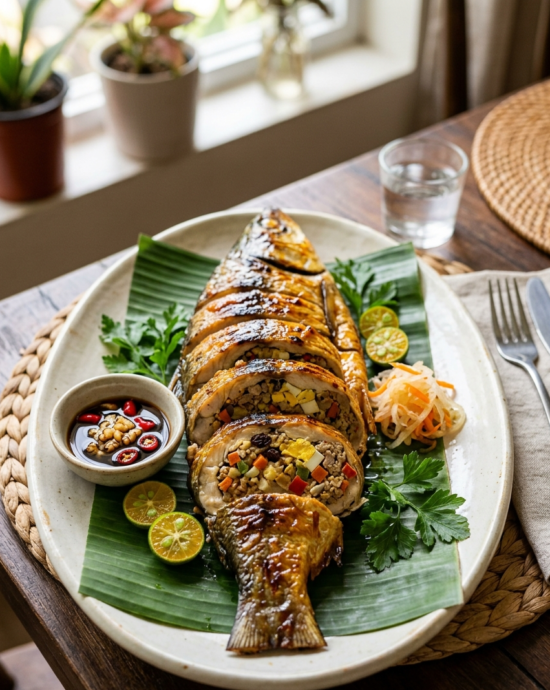
Heat one cup of cooking oil in a large, wide frying pan or wok over medium-high heat. The oil should come at least halfway up the side of the stuffed fish. Carefully lower the filled bangus into the hot oil and fry for five to seven minutes on the first side until the skin is deeply golden-brown and crisped. The skin should fry to a beautifully burnished, shiny golden color. Carefully flip the fish using two wide spatulas to support both ends simultaneously, and fry the other side for another five to seven minutes until equally golden. Remove the fish from the oil and drain on a wire rack or paper towels. Allow the finished relyenong bangus to rest for five minutes before carefully removing all toothpicks or twine. Slice crosswise into generous rounds of three to four centimeters and arrange on a platter. The stuffed cross-sections reveal the beautiful mosaic of fish, pork, vegetables, and raisins within.
- Calories:340 kcal17%
- Protein:26 g52%
- Carbohydrates:16 g5%
- Sugar:6 g7%
- Fat:19 g24%
Table of Contents
What Is Relyenong Bangus?
Relyenong Bangus is a celebrated Filipino festive dish consisting of a whole bangus (milkfish) whose flesh has been extracted from the skin, deboned, mixed with ground pork, vegetables, eggs, raisins, and aromatics, then stuffed back into the intact fish skin and fried until golden. It is widely considered one of the most technically demanding and prestigious dishes in the Filipino culinary canon, and is closely associated with the Kapampangan cooking tradition of Pampanga province — a region renowned throughout the Philippines for producing some of the country’s most skilled and imaginative home cooks and chefs. The term relleno derives from Spanish, meaning stuffed or filled, reflecting the deep Spanish colonial influence on Filipino festive cooking, where elaborate stuffed preparations became a hallmark of fiesta cuisine. What makes relyenong bangus particularly remarkable is the labor-intensive process of extracting the fish flesh from the intact skin — a technique that requires patience, practice, and a confident touch to achieve without tearing the delicate skin that serves as the serving vessel. The resulting dish is visually stunning: a whole golden-brown fried fish that, when sliced, reveals a vibrant mosaic of savory filling ingredients. The flavor profile is distinctively Filipino: savory and umami-rich from the pork and soy sauce, subtly sweet from the raisins and carrots, fragrant from garlic and onion, with the rich milkfish providing the essential oceanic foundation. Relyenong bangus occupies a cherished position in the Filipino celebration table — a dish that signals special occasion, culinary pride, and the loving dedication of the cook who prepared it.
Ingredient Notes
- Bangus (Milkfish): Choose a large, fresh bangus of at least one kilogram. Larger fish have a more substantial skin tube that is easier to extract without tearing. Look for firm, fresh fish with clear eyes and bright red gills.
- Ground Pork: Use regular-fat ground pork rather than lean — the fat adds moisture to the stuffing and prevents it from becoming dry during frying. The pork and fish flesh combination is essential to the dish’s characteristic flavor.
- Raisins: The signature Kapampangan addition that defines authentic relyenong bangus. Do not omit — the sweet-fruity bursts of raisin against the savory filling is a deliberate and beloved contrast.
- Eggs: Large fresh eggs bind the stuffing so it holds together cleanly when sliced. Three eggs for a one-kilogram fish is the standard ratio. Using cold eggs straight from the refrigerator can tighten the mixture prematurely.
- Soy sauce: Use a good-quality Filipino soy sauce like Silver Swan or Marca Pina for the marinade and stuffing. It provides the savory-salty foundation of the filling’s seasoning profile.
Ingredient Suggestions
- Chorizo de Bilbao, sliced thin: Adding a few thin slices of this cured Spanish-style sausage to the stuffing introduces smoky, paprika-spiced depth that elevates the entire filling.
- Pickle relish (sweet): A tablespoon of sweet pickle relish adds tangy-sweet notes and a traditional touch found in many classic Kapampangan relyenong bangus recipes.
- Queso de bola (Edam cheese), grated: A small handful of grated Edam mixed into the stuffing adds creamy, salty richness characteristic of Filipino festive cooking.
- Ham (cooked), finely diced: Diced ham adds a sweet, cured pork dimension that pairs naturally with the raisins and enhances the overall complexity of the filling.
- Hard-boiled egg, halved: Placing halved hard-boiled eggs in the center of the stuffing creates a beautiful cross-section presentation when the stuffed fish is sliced at the table.
Helpful Tips & Pro Tips
- Practice the skin extraction technique. The flesh-from-skin removal is the most difficult part of relyenong bangus. If the skin tears, patch small holes with overlapping skin edges — they seal during frying. Watch video demonstrations before your first attempt to understand the feel.
- Cool the stuffing completely before adding eggs. Hot stuffing cooks the egg immediately upon contact, producing a scrambled egg-studded filling rather than a smooth, evenly bound mixture. Allow at least ten minutes of cooling time.
- Do not overstuff the skin. Overpacking causes blowouts during frying as the filling expands from heat. Fill to just shy of the fish’s original volume, leaving a little room for expansion. The sewn or toothpick-sealed opening will hold.
- Use two spatulas when flipping. A stuffed one-kilogram fish is fragile and top-heavy. Slide one spatula under the head end and another under the tail simultaneously for a stable, controlled flip without breaking the fish.
- Rest before slicing. Allowing the fried fish to rest for five minutes after frying lets the internal temperature equalize and the binding eggs to set fully, resulting in clean, intact slices rather than crumbling filling.
How to Serve and Store
Relyenong bangus is best served hot, sliced at the table into generous rounds of 3–4 cm thickness. Arrange the slices cut-side up on a platter to display the colorful filling cross-section. Serve with steamed white rice and a side of banana ketchup, sweet chili sauce, or spiced vinegar. Leftover relyenong bangus stores excellently in the refrigerator for up to 3 days in an airtight container. Reheat slices in a lightly oiled pan over medium heat for 3–4 minutes per side to restore the crust’s crispiness. Avoid microwaving, which softens the skin. The stuffed, unfried fish can be refrigerated for up to 24 hours before frying — wrap tightly in cling film. For freezing, wrap individual slices of fried, cooled relyenong bangus in cling film and freeze for up to 1 month; reheat in oven at 180°C for 15 minutes.
Substitutions
- Bangus → Large tilapia: A smaller whole tilapia can be used for a scaled-down version; the skin extraction technique is the same but requires extra care due to the tilapia’s thinner, more fragile skin.
- Ground pork → Ground chicken: For a lighter filling, ground chicken provides similar texture with less fat; add a teaspoon of sesame oil for additional richness to compensate.
- Raisins → Dried cranberries or currants: Both provide the sweet-tart fruit element that defines authentic relyenong bangus when raisins are unavailable.
- Fresh vegetables → Frozen mixed vegetables: For convenience, a cup of thawed frozen mixed peas, carrots, and corn is a practical substitute that maintains color and nutritional value.
- Pan frying → Oven baking (lower-fat option): Brush the stuffed fish generously with oil and bake at 200°C for 30–35 minutes, turning once halfway, for a lower-fat alternative that still achieves good browning.
Suggested Recipes
- Embutido (Filipino Pork Meatloaf): Shares the same stuffing technique and festive spirit — ground pork rolled with hard-boiled eggs, raisins, and vegetables in a similar filling profile.
- Morcon (Beef Roulade): Another elaborate Filipino fiesta dish involving stuffed and rolled beef, representing the same Kapampangan tradition of celebratory stuffed meats.
- Daing na Bangus: A simple, everyday bangus preparation that provides delicious contrast to the elaborate, festive nature of relyenong bangus.
- Lechon (Whole Roasted Pig): The ultimate Filipino fiesta centerpiece — often served alongside relyenong bangus at Kapampangan celebration tables.
Frequently Asked Questions

Jeff Smith
"Cooking is the intersection of history, science, and emotion."
For me, the kitchen has always been a laboratory of culture. With a background deeply rooted in digital strategy and precision, I approach the culinary arts with the same rigor I apply to the digital landscape—analyzing flavors, perfecting techniques, and documenting the nuance that makes Filipino cuisine truly world-class.
Findme Recipe was born from a desire to bridge the gap between traditional heritage and the modern home cook. Whether it is mastering the perfect balance of acidity in a classic Adobo or simplifying complex regional dishes for everyday kitchens, my mission is to preserve our culinary identity through accessible, data-backed, and delicious content.
I am not just building a database; I am cultivating a community where every Filipino kitchen feels empowered, every ingredient is celebrated, and every family heirloom recipe finds a place to thrive.
Join me as we translate the soul of our islands into recipes for the next generation.