
- Step 1: Prepare and Season the Pig

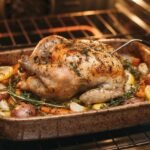
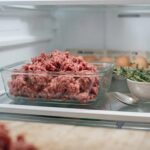
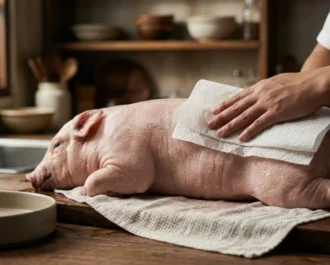
Rinse the whole pig thoroughly inside and out under cold running water, removing any remaining innards, and pat completely dry with paper towels. Generously rub rock salt over every surface of the pig — both inside the cavity and all over the exterior skin — pressing it firmly into every surface, fold, and crevice. The salt serves multiple purposes: it draws moisture from the skin surface through osmosis, seasons the pork deeply, and begins the dehydration process that is critical for achieving the legendary crackling skin of authentic litson baboy. Pay particular attention to the cavity interior — season it as generously as the exterior. Cover the salted pig loosely and refrigerate overnight, uncovered, for a minimum of 8 to 12 hours to allow the salt to penetrate deeply and the skin to dry thoroughly.
- Step 2: Prepare the Stuffing and Stuff the Cavity
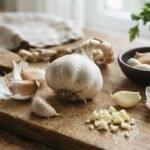
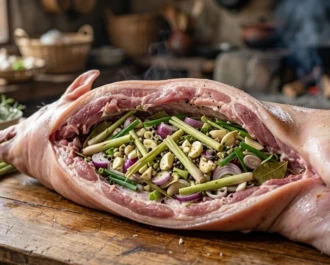
The aromatic stuffing packed into the pig's cavity is the source of litson baboy's extraordinary, signature internal fragrance — it perfumes the meat from the inside throughout the entire long roasting process. Line the inside of the cavity with washed banana leaves, shiny side facing inward, to impart their distinctive, grassy-sweet fragrance to the cooking environment inside the pig. Pack the cavity generously and firmly with the bruised lemongrass stalks, halved garlic head, quartered onions, spring onions, thick ginger slices, bay leaves, whole peppercorns, and star anise. The cavity should be filled completely and tightly — a generous stuffing creates more aromatic steam to circulate and a more intensely flavored finished pork. Sew the cavity closed tightly with kitchen twine or seal with metal skewers so the stuffing remains compressed throughout roasting.
- Step 3: Prepare the Spit and Basting Sauce
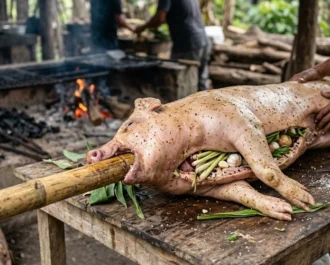
Thread the prepared, stuffed pig onto the roasting spit — a long, thick bamboo or metal rod that runs the entire length of the pig from snout to tail. The pig must be centered and balanced on the spit so it rotates evenly during roasting without favoring one side. Tie the legs and head securely to the spit rod using kitchen twine or metal wire to prevent flopping during rotation. In a small bowl, whisk together the soy sauce, vinegar, cooking oil, calamansi juice, brown sugar, and minced garlic to create the basting sauce. This basting sauce will be applied continuously throughout the roasting process, building a lacquered, deeply flavored, beautifully browned skin layer by layer. Prepare a large quantity — you will use it generously and frequently throughout the entire 4 to 5 hours of roasting.
- Step 4: Begin Roasting Over Coals
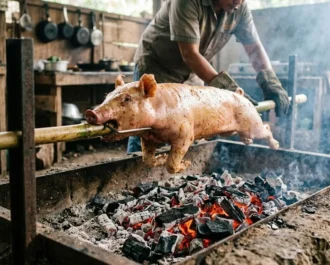
Position the pig on the spit over a prepared bed of hot charcoal. The charcoal bed should be approximately 40 to 50 centimeters below the pig — close enough for effective heat transfer but far enough to prevent flare-ups from dripping fat from scorching rather than browning the skin. Begin rotating the spit slowly and continuously from the very first moment — uneven rotation produces unevenly cooked, unevenly colored skin. Begin basting every 15 minutes with the prepared basting sauce, applying it generously with a brush over every visible surface of the skin. The first hour of roasting is a gentle, steady process during which the pig's exterior begins to set and dry, the fat beneath the skin starts to render, and the first, subtle golden color begins developing on the skin's surface.
- Step 5: The Critical Middle Hours — Build the Color
During the second and third hours of roasting, the pig's skin transitions through pale gold, then deeper amber, then a rich, increasingly dark mahogany brown as the fat continues rendering and the basting sauce caramelizes layer upon layer onto the surface. Maintain the charcoal heat consistently during this period — add fresh coals as needed to prevent the temperature from dropping. Continue rotating the spit continuously and basting every 15 minutes without exception. If sections of skin begin browning too rapidly, wrap those areas loosely in aluminum foil to protect them while the rest of the pig catches up. The pig is developing correctly when you can hear the fat inside actively sizzling and see the skin tightening, darkening, and beginning to develop a beautiful sheen from the accumulated basting layers.
- Step 6: Finish, Rest, and Carve
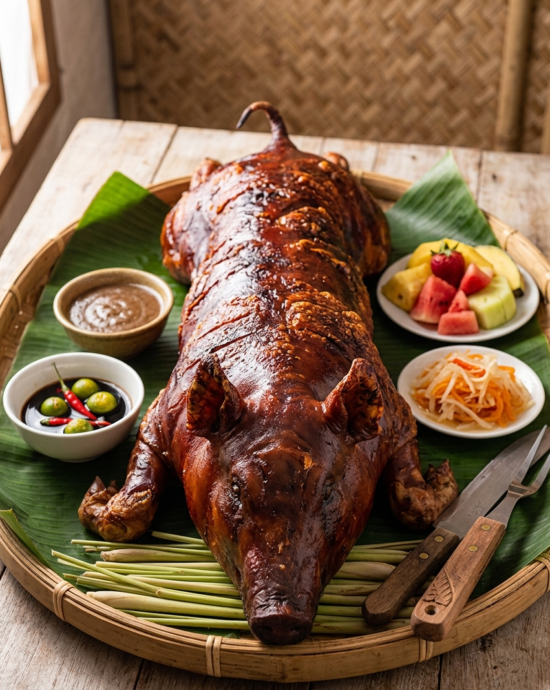
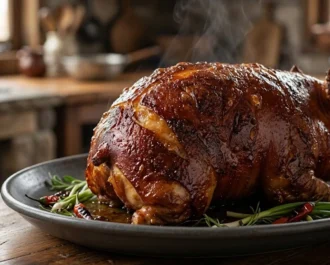
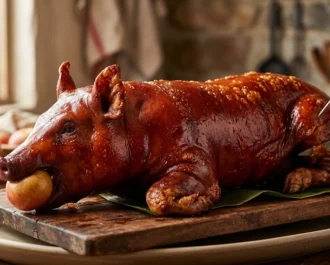
The pig is done when the internal temperature at the thickest part of the thigh reads 74°C (165°F) and the skin has turned a deeply burnished, even mahogany-red color across every surface. Tap the skin — it should produce a hollow, drum-like sound rather than a soft thud when struck with a knuckle. Remove the pig from the spit and transfer to a large carving board or table. Allow the whole pig to rest for a minimum of 20 to 30 minutes before carving — this essential rest allows the extraordinary amount of rendered fat and juices to redistribute throughout the meat. Crack the crackling by pressing firmly with a cleaver or carving knife. Carve by removing the crackling in large sheets first, then slicing the tender meat underneath, serving both together with lechon sauce.
- Calories:520 kcal26%
- Energy:2,176 kJ26%
- Protein:36 g72%
- Carbohydrates:6 g2%
- Sugar:2 g2%
- Fat:38 g49%
- Salt:1.3 g22%
Table of Contents
What Is Litson Baboy?
Litson baboy is a whole Filipino spit-roasted pig — cooked over live charcoal for four to five hours until the skin achieves its legendary mahogany-red, shatteringly crispy crackling while the meat inside remains extraordinarily tender, juicy, and perfumed with lemongrass, garlic, and star anise aromatics — the most celebrated, most culturally significant, and most deeply anticipated dish in the entire Filipino culinary canon. No other preparation in the Philippines carries the same weight of celebration, community, and festive abundance as lechon. Its presence at a table signals that something important is being celebrated — a birthday, a wedding, a Christmas gathering, a town fiesta — and its arrival is invariably greeted with excitement and reverence.
The preparation of litson baboy is a communal ritual as much as a cooking process. The pig must be turned on its spit by hand throughout the entire four to five hours of roasting — a task traditionally shared among family members and neighbors who take turns rotating, basting, and tending the coals. This shared labor deepens the communal bond around the preparation and elevates the finished dish from mere food to a shared achievement.
Regional variations of lechon vary dramatically across the Philippines. Cebu lechon is the most internationally celebrated — seasoned minimally with salt and loaded with lemongrass and garlic, it requires no dipping sauce because the flavor of the perfectly seasoned, aromatic meat stands completely on its own. Manila-style lechon tends to be larger, more generously spiced, and served with liver-based lechon sauce. Both are extraordinary in their own right and represent the full, magnificent range of Filipino pork cookery at its most ambitious and most joyful.
Ingredient Notes
- Whole Pig (Suckling or Market Pig): The ideal lechon pig for home or small gatherings is a suckling pig (lechon de leche) of 6 to 8 kg — young enough that the skin is thin and crackles magnificently, but substantial enough to feed 20 to 30 people. Larger market pigs of 15 to 20 kg are used for bigger celebrations but require significantly longer roasting and more experienced spit management. Source from a reputable butcher who can clean and prepare the pig for roasting.
- Rock Salt: Applied generously inside and out, rock salt is the primary seasoning vehicle for litson baboy’s exterior. Coarse rock salt dehydrates the skin more effectively than fine salt and allows for more even coverage over large surface areas. Do not be timid with the salt — generous application is the rule for lechon, not the exception.
- Lemongrass (Tanglad): The aromatic heart of the lechon cavity stuffing and the ingredient most responsible for Cebu lechon’s legendary, distinctive flavor. Use the maximum amount of lemongrass possible — traditional Cebu lechon uses entire bunches. The bruised stalks must be packed tightly inside the cavity to concentrate their citrusy, floral perfume.
- Star Anise: A component of the stuffing that contributes a warm, anise-forward complexity characteristic of the Chinese-Filipino culinary influence present in many classic Filipino celebration dishes. Star anise’s sweet, spicy aroma blends beautifully with the lemongrass and garlic, contributing to the complex internal fragrance of the finished pig.
- Banana Leaves: Lining the cavity with banana leaves before adding the stuffing is a traditional technique that imparts a subtle, grassy sweetness to the internal steam environment and protects the stuffing aromatics from the direct fat of the pig’s interior cavity during the long roast.
Ingredient Suggestions
- Tanglad (lemongrass) in abundance — Cebu-style lechon uses an almost excessive quantity of lemongrass packed into the cavity; for the most aromatic, celebrated version, triple the amount of lemongrass called for in the base recipe.
- Pandan leaves — Added to the cavity alongside the lemongrass, pandan contributes a sweet, vanilla-like fragrance that adds another layer of aromatic complexity to the finished pork.
- Muscovado sugar in the basting sauce — Replacing white sugar in the basting sauce with muscovado gives a more complex, molasses-rich caramelization that deepens the skin’s color and flavor.
- Beer or calamansi in the basting liquid — Adding a cup of beer or a generous amount of calamansi juice to the basting sauce introduces a slight fermented or citrusy note that complements the roasted pork beautifully.
- Annatto seeds in the basting oil — Steeping annatto seeds in the basting oil produces the characteristic deep orange-red tint on the skin associated with the most visually stunning lechon presentations.
Helpful Tips & Pro Tips
- Rotate the spit continuously and without gaps. The most common lechon failure is uneven skin color and uneven cooking caused by irregular, infrequent rotation. The spit must turn slowly but continuously throughout the entire roasting period — set a timer if necessary to ensure basting and rotation happen consistently every 15 minutes without exception.
- Manage the charcoal distance carefully. The pig should roast at a distance of 40 to 50 centimeters above the coals — close enough for steady, effective heat but far enough to prevent flare-ups when fat drips. Flare-ups char the skin unevenly and create burnt patches that cannot be corrected. Keep a spray bottle of water nearby to control flare-ups immediately.
- Why is my lechon skin pale and not crackling? Pale, soft lechon skin almost always results from insufficient overnight drying before roasting, oil-based basting applied too early (which prevents the skin from drying), or insufficient heat during roasting. Ensure the skin is bone-dry before placing over coals; begin basting with the soy-vinegar mixture only after the skin is visibly set and beginning to color.
- The rest is non-negotiable. A whole pig contains an enormous quantity of rendered fat and juices that are driven toward the surface by the heat of roasting. Allowing 20 to 30 minutes of resting before carving allows these juices to redistribute throughout the meat — carving immediately results in a significant loss of the flavorful juices that make the meat so extraordinarily succulent.
- Listen to the crackling. Perfectly done lechon crackling makes a hollow, resonant sound when tapped with a knuckle — like tapping a drum. Soft or dull tapping indicates the skin needs more time or more heat. The crackling is ready when it sounds and behaves like a rigid, hollow shell rather than soft pork skin.
How to Serve and Store
Serve litson baboy as a dramatic, whole-table centerpiece by removing the spit and placing the entire roasted pig on a large banana-leaf-lined table or carving board. The crackling should be cracked and removed in large sheets first — these are the most prized pieces, distributed first to honored guests. Accompany with lechon sauce, spiced vinegar, steamed rice, and traditional Filipino side dishes like pansit, kare-kare, and fresh tomato salad.
Store leftover lechon covered in the refrigerator for up to 3 days. The best use of leftover lechon is lechon paksiw — simmering the pieces in lechon sauce and vinegar into a completely different but equally extraordinary dish. Reheat leftover pieces in a 200°C oven for 10 minutes to partially restore the crackling. Freeze portioned leftovers for up to 1 month; thaw overnight before reheating.
Substitutions
- Whole pig → Whole pork belly slab (2 kg) — A dramatically more manageable home-kitchen alternative that uses the same seasoning and basting technique; roast at 180°C in the oven for 2.5 hours.
- Charcoal spit → Oven roasting — Set a prepared pork belly skin-side up on a rack in a 160°C oven for 2 hours, then increase to 230°C for 30 minutes for the crackling finish.
- Lemongrass → Kaffir lime leaves + lemon zest — An aromatic substitute for the cavity stuffing when fresh tanglad is unavailable; provides comparable citrusy, floral notes.
- Soy sauce (basting) → Coconut aminos — A gluten-free basting substitute with comparable color and saltiness.
- Rock salt → Coarse sea salt — An equally effective dehydrating and seasoning agent; use the same generous quantity.
- Star anise → Five-spice powder (½ tsp) — A convenient substitute that approximates the warm, anise-forward aromatic note in the cavity stuffing.
Suggested Recipes
- Lechon Kawali — The everyday home-kitchen version of the lechon crackling experience using pork belly; perfect for when a whole roasted pig is impractical.
- Lechon Paksiw — The brilliant leftover transformation of lechon into a sweet-sour braised dish; the day after the celebration, this is often the most anticipated meal.
- Crispy Pata — Deep-fried pork knuckle that celebrates the same Filipino obsession with extraordinary pork crackling in a single-serving, manageable format.
- Cochinillo Asado — The Spanish-style roasted suckling pig that shares litson baboy’s Spanish culinary ancestry and is a natural comparison dish for understanding the Filipino lechon tradition.
Frequently Asked Questions

Jeff Smith
"Cooking is the intersection of history, science, and emotion."
For me, the kitchen has always been a laboratory of culture. With a background deeply rooted in digital strategy and precision, I approach the culinary arts with the same rigor I apply to the digital landscape—analyzing flavors, perfecting techniques, and documenting the nuance that makes Filipino cuisine truly world-class.
Findme Recipe was born from a desire to bridge the gap between traditional heritage and the modern home cook. Whether it is mastering the perfect balance of acidity in a classic Adobo or simplifying complex regional dishes for everyday kitchens, my mission is to preserve our culinary identity through accessible, data-backed, and delicious content.
I am not just building a database; I am cultivating a community where every Filipino kitchen feels empowered, every ingredient is celebrated, and every family heirloom recipe finds a place to thrive.
Join me as we translate the soul of our islands into recipes for the next generation.