
- Step 1: Create the Batangas-Style Pork Broth
The foundation of Lomi Batangas is its intensely rich, porky broth — deeper and more concentrated than the broth used in standard Filipino lomi. Start by simmering pork bones (at least 500 grams of neck bones or knuckles) in four cups of water with crushed garlic, whole peppercorns, and half an onion for forty-five minutes to one hour over medium-low heat. Lomi Batangas is known for its distinctly stronger pork flavor compared to other regional lomi variations, and this bone-intensive broth approach is how authentic Batangas carinderias achieve that characteristic richness. Skim the broth diligently during the first fifteen minutes to remove gray foam. The finished broth should be golden, very slightly cloudy (this is normal for pork bone broth), and intensely aromatic. Season with fish sauce and white pepper. The use of lard instead of cooking oil is traditional and adds an irreplaceable richness to the sauté base.
- Step 2: Sauté in Lard for Authentic Batangas Flavor
Heat the lard in a large, heavy-bottomed pot or wok over medium-high heat. Lard is the traditional cooking fat of Batangas cuisine and is responsible for the distinctive rich, porky flavor that sets Lomi Batangas apart from versions cooked in vegetable oil. The lard should melt and become liquid quickly, at which point add the minced garlic and cook until golden, about one minute. Immediately add the diced onions and cook until very soft and slightly caramelized — the longer the onions cook at this stage, the sweeter and more complex the flavor base becomes. Add the sliced pork shoulder and cook over high heat until golden brown on all sides, about five to six minutes. The high-heat browning of the pork in lard creates deeply caramelized, savory flavors through the Maillard reaction that are the unmistakable signature of a properly made Lomi Batangas.
- Step 3: Add Liver and Season the Meats
Once the pork shoulder is browned, add the very thinly sliced pork liver to the pan. Liver is a defining ingredient in Lomi Batangas that makes it distinct from standard Filipino lomi recipes, which sometimes omit it. Stir-fry the liver with the pork for just two minutes until it changes color from deep red to a uniform grayish-brown — the liver must not be overcooked at this stage as it will continue cooking in the hot broth. Season the meats with the oyster sauce, fish sauce, and a generous pinch of white pepper, tossing to coat everything evenly. The white pepper is important in Lomi Batangas — it provides a clean, penetrating heat without the slightly floral bitterness of black pepper, which would compete with the deep pork and liver flavors of the broth. The seasoned meat mixture at this point should smell intensely savory and deeply porky.
- Step 4: Add Broth and Cook the Noodles
Pour all of the prepared pork bone broth into the pot with the browned meats and aromatics. Bring to a rolling boil over high heat, scraping any caramelized bits from the bottom of the pot into the liquid — these browned bits are concentrated flavor. Once boiling, add the fresh lomi noodles, pushing them gently into the broth to submerge them. Cook for three to four minutes at a steady boil, stirring occasionally to prevent the noodles from clumping together. Lomi Batangas uses the same thick, fresh egg noodles as regular lomi but the higher proportion of pork broth and liver in the recipe gives the finished dish a more intense, complex character. Taste the soup at this stage and make any necessary adjustments with additional fish sauce, white pepper, or a small pinch of salt.
- Step 5: Thicken with Cornstarch and Add Egg Drop
Reduce the heat to medium once the noodles are just tender. Pour the cornstarch slurry slowly and steadily into the simmering soup while stirring in constant, circular strokes. The broth will visibly thicken within sixty to ninety seconds, transitioning from a clear, thin liquid to a glossy, coating consistency. For Lomi Batangas specifically, the broth is traditionally thickened slightly more than regular lomi — it should have the consistency of a very light gravy that heavily coats the noodles and the back of a spoon. Add additional cornstarch slurry one teaspoon at a time if a thicker result is desired. Once the desired consistency is achieved, pour the beaten eggs in a slow, steady stream while stirring gently in one direction, creating long, silky ribbons of cooked egg throughout the thick broth. Stir for thirty seconds more to distribute the egg evenly.
- Step 6: Serve with Signature Batangas Garnishes
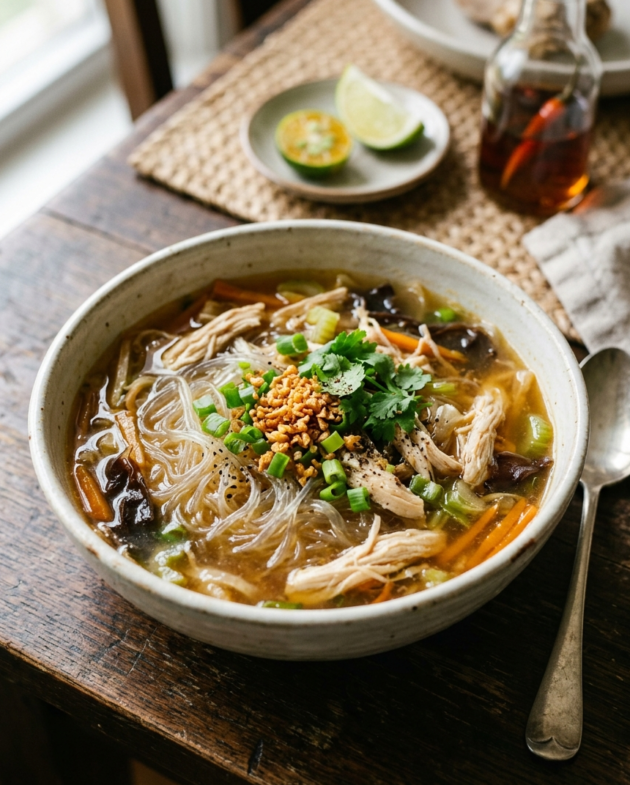
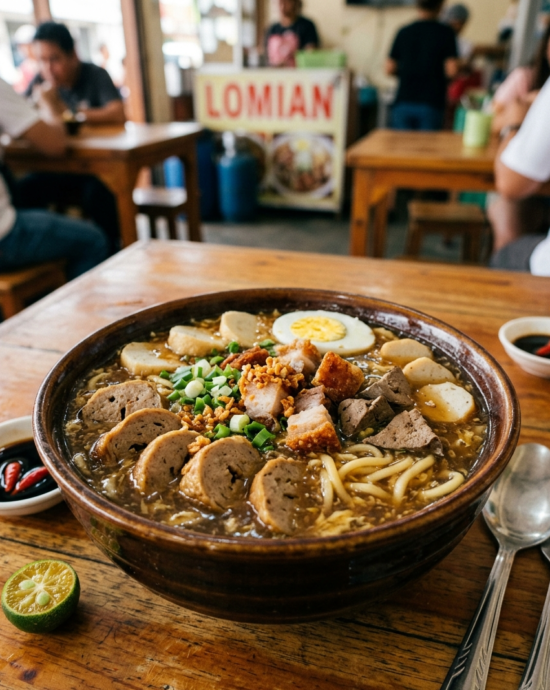
Ladle the thick, steaming Lomi Batangas into deep bowls immediately — even more urgently than regular lomi, as the thicker, liver-enriched broth sets and solidifies more quickly as it cools. Each bowl should be generously filled with noodles, pork and liver pieces, and plenty of the thick broth. Top each bowl with a substantial mound of crushed chicharon — this is essential in Lomi Batangas, where the pork cracklings add both textural contrast and additional intense pork flavor. Finish with sliced spring onions and a scattering of toasted garlic over the top. Place a calamansi half on the rim of each bowl — the citrus is not optional in Lomi Batangas; locals squeeze it directly into the broth before eating, creating an essential acidic brightness that cuts through the richness of the lard, liver, and thick broth. Serve with spiced vinegar on the side.
- Calories:520 kcal26%
- Protein:30 g60%
- Carbohydrates:60 g20%
- Sugar:3 g3%
- Fat:18 g23%
Table of Contents
What Is Lomi Batangas?
Lomi Batangas is the definitive regional variation of Filipino lomi noodle soup, originating from Batangas province in Southern Luzon, and widely regarded as the gold standard of all Filipino lomi preparations. While regular Filipino lomi exists throughout the country, Lomi Batangas has a fervent, almost cult-like following among food enthusiasts who make special trips to Batangas specifically for the experience of eating it at one of the province’s legendary lomi houses (lomi-han). The dish is distinguished from other lomi variations by several defining characteristics: an intensely pork-forward broth made from long-simmered bones, the inclusion of pork liver as a standard ingredient, the traditional use of lard as the cooking fat, an extra-thick cornstarch-thickened broth that verges on gravy-like, and the indispensable garnish of crushed chicharon. The broth’s remarkable depth of flavor comes from the combination of pork bone stock, rendered lard, and liver — the latter adding an iron-rich, slightly bitter note that creates a complexity missing in lighter versions of the dish. Batangas lomi houses typically cook their broth in giant, continuously simmering pots that develop flavor over the course of an entire day, a luxury impossible to replicate at home but one that home cooks approximate by making the most intensely flavored bone broth possible. What makes Lomi Batangas a true destination dish is the ritual of eating it: squeezing calamansi directly into the bowl, mixing the crushed chicharon into the thick broth, and experiencing how all the elements — noodles, meats, thick broth, crispy pork, citrus — combine into a perfectly balanced bowl of comfort.
Ingredient Notes
- Lard: Traditional Lomi Batangas is cooked in pork lard rather than vegetable oil, which imparts an incomparable richness and depth of pork flavor to the sauté base. If using lard from a Filipino butcher or rendering your own, the result will be noticeably more authentic than commercial vegetable shortening.
- Pork Liver: Pork liver is a standard ingredient in Lomi Batangas, adding both flavor complexity and an iron-rich depth to the broth. Slice it no more than two to three millimeters thin so it cooks through quickly without becoming tough, and add it last among the proteins to prevent overcooking.
- Calamansi: Calamansi is absolutely non-negotiable in Lomi Batangas — Batangueños squeeze it liberally into their bowls, and it transforms the experience by cutting through the richness of the thick, lard-based broth. Fresh calamansi is ideal; bottled juice is an acceptable substitute but lacks the fragrant oils of the fresh fruit.
Ingredient Suggestions
- Pork Meatballs — Add homemade or store-bought pork meatballs for extra meatiness and a visually appealing presentation.
- Duck Egg — A salted duck egg halved over the top of the finished bowl adds briny, creamy richness traditional in Batangas cooking.
- Extra Lard Drizzle — A small drizzle of hot lard over the finished bowl — the way many old-school lomi houses serve it — intensifies the pork flavor dramatically.
- Fried Tofu — Add cubed, deep-fried firm tofu for a textural contrast that absorbs the flavored broth beautifully.
Helpful Tips & Pro Tips
- The broth is the soul of Lomi Batangas. Make it at least a day ahead if possible and refrigerate overnight — the fat will solidify on top for easy removal, the flavors will deepen significantly, and the gelatin from the bones will create an incredibly rich, mouth-coating result that fresh broth cannot match.
- Do not use pre-packaged, instant noodles for Lomi Batangas — the fresh lomi noodles are essential. Their thick, slightly alkaline, chewy character absorbs the thick broth in a way that no dried noodle can replicate. Find fresh lomi noodles at any Filipino wet market, Asian grocery, or Filipino specialty store.
- For the most authentic result, use rendered pork lard rather than commercial vegetable oil. Lard has a higher smoke point than many oils and an incomparable richness. Render your own by cooking cubed pork fat slowly in a pot over low heat until the fat melts and the solids turn crispy — strain and refrigerate the resulting clear liquid fat.
- Why is my Lomi Batangas not as thick as restaurant versions? Professional lomi houses often use a higher ratio of cornstarch than home recipes suggest. For restaurant-level thickness, increase the cornstarch to three and a half to four tablespoons per two cups of broth, and allow it to simmer for a full two minutes after adding before the egg drop.
How to Serve and Store
Lomi Batangas is served exclusively hot and immediately — unlike some dishes that improve with resting, lomi must reach the diner while the broth is at maximum thickness and the chicharon still has some crunch. Serve with extra calamansi, spiced vinegar, and fish sauce on the table. Store leftovers in an airtight container for up to two days — the noodles will absorb most of the broth overnight, requiring a generous addition of fresh pork broth and a small amount of cornstarch slurry when reheating. Add fresh chicharon and calamansi to each reheated bowl.
Substitutions
- Lard → Rendered chicken fat (schmaltz) — Provides similar richness with a different but still deeply savory flavor profile.
- Pork liver → Chicken liver — More widely available and milder in flavor; still provides the essential iron-rich depth characteristic of Lomi Batangas.
- Fresh lomi noodles → Thick udon noodles — The best dried/fresh alternative that closely mimics the thick, chewy character of lomi noodles.
- Pork shoulder → Pork tenderloin — For a leaner, more tender pork option that cooks more quickly in the broth.
- Chicharon → Fried garlic and sesame seeds — Provides crunch and aroma for those who prefer to avoid fried pork skin.
- Fish sauce → Low-sodium soy sauce — Reduces the overall sodium content while maintaining umami depth in the broth.
Suggested Recipes
- Standard Lomi — The nationwide Filipino lomi that shares the same thick broth and noodle tradition but in a lighter, more accessible version.
- Batchoy Tagalog — Another hearty Luzon pork-and-offal soup that shares Lomi Batangas’s bold, unapologetic flavor character.
- Bulalo — The famous Batangas beef marrow soup that showcases the same bone broth depth in a beef-forward format.
- Pancit Batil Patung — Another regional Filipino noodle dish with bold, layered toppings that showcases Philippine noodle diversity.
Frequently Asked Questions

Jeff Smith
"Cooking is the intersection of history, science, and emotion."
For me, the kitchen has always been a laboratory of culture. With a background deeply rooted in digital strategy and precision, I approach the culinary arts with the same rigor I apply to the digital landscape—analyzing flavors, perfecting techniques, and documenting the nuance that makes Filipino cuisine truly world-class.
Findme Recipe was born from a desire to bridge the gap between traditional heritage and the modern home cook. Whether it is mastering the perfect balance of acidity in a classic Adobo or simplifying complex regional dishes for everyday kitchens, my mission is to preserve our culinary identity through accessible, data-backed, and delicious content.
I am not just building a database; I am cultivating a community where every Filipino kitchen feels empowered, every ingredient is celebrated, and every family heirloom recipe finds a place to thrive.
Join me as we translate the soul of our islands into recipes for the next generation.