
- Make the marinade paste
Using a mortar and pestle, pound the cilantro roots, garlic, and white peppercorns together into a coarse, fragrant paste. This trio forms the aromatic backbone of the marinade, and pounding rather than mincing releases more of their essential oils, giving the finished pork a deeper, more rounded flavor than store-bought minced versions would.
- Combine the marinade
Transfer the pounded paste to a bowl and stir in the oyster sauce, fish sauce, palm sugar, coconut milk, and light soy sauce until the sugar dissolves and everything is well combined. Taste the marinade, which should lean slightly sweet and savory with a strong garlicky backbone, since this balance defines the classic Moo Ping flavor.
- Marinate the pork
Add the thinly sliced pork shoulder to the marinade, tossing to coat every piece thoroughly. Cover and refrigerate for at least four hours, though overnight yields even better results, as the sugar and salt slowly tenderize the meat and infuse it with flavor all the way through.
- Thread the skewers
Remove the pork from the refrigerator and thread the marinated slices onto the pre-soaked bamboo skewers, weaving each piece back and forth two or three times so it stays secure and lies relatively flat for even grilling. Let the skewers sit at room temperature for about fifteen minutes before grilling.
- Grill the skewers
Preheat a grill or grill pan to medium-high heat. Grill the skewers for about five to six minutes per side, basting occasionally with any remaining marinade during the first few minutes, until the pork is caramelized at the edges and cooked through with an internal temperature of 145°F.
- Rest and serve
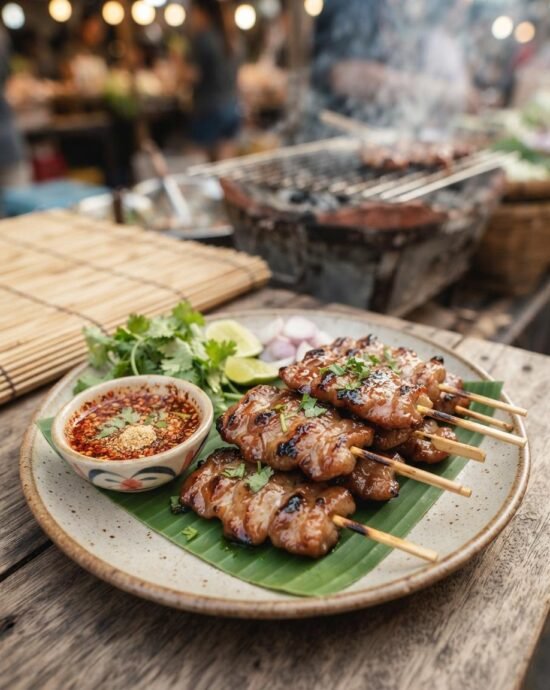
Transfer the skewers to a platter and let them rest for a couple of minutes before serving. Moo Ping is traditionally served with sticky rice and a side of sweet chili sauce or a spicy dipping sauce called nam jim jaew for dunking.
- Calories:290 kcal15%
- Protein:26 g52%
- Carbohydrates:10 g3%
- Sugar:8 g16%
- Energy:1215 kJ15%
- Salt:1.4 g61%
- Fat:16 g21%
What Is Moo Ping?
Moo Ping is Thailand’s answer to grilled pork skewers, marinated in a sweet and savory blend of coconut milk, fish sauce, garlic, and cilantro root before being charred over an open flame until caramelized at the edges. It’s a fixture of morning street food in Thailand, sold from smoky charcoal grill carts often set up right on the sidewalk, where the aroma alone is usually enough to draw in customers well before they see the food itself.
The dish is thought to have Thai-Lao and Isaan regional roots, where grilling meat over charcoal has long been a practical, portable way to cook and sell food on the street. What sets Moo Ping apart from other grilled pork dishes across Southeast Asia is the specific marinade combination, particularly the use of cilantro root, which delivers a deeper, earthier flavor than the leaves alone, and coconut milk, which helps tenderize the meat while adding subtle richness.
The thin slicing of the pork shoulder matters as much as the marinade itself, since thin cuts absorb flavor quickly and cook fast over high heat, developing a caramelized char on the outside while staying juicy within. Vendors typically grill the skewers in batches over glowing coals, turning them frequently to build an even, slightly sticky glaze from the marinade’s natural sugars.
Moo Ping is almost always paired with sticky rice, sold together as an inexpensive, filling breakfast or snack throughout the day. The combination of smoky, sweet pork and warm sticky rice, often eaten by hand, is one of the most recognizable and comforting street food pairings in all of Thai cuisine.
Ingredient Notes
- Pork shoulder: Its marbled fat keeps the meat juicy over high heat, which is essential since the thin slicing used for skewers cooks quickly. Choose shoulder with visible streaks of fat rather than a very lean cut.
- Cilantro roots: Cilantro roots deliver a deeper, earthier flavor than the leaves alone and are considered essential in authentic Thai marinades. If unavailable, the stems are the closest substitute, though the flavor will be milder.
- Palm sugar: Palm sugar caramelizes beautifully on the grill, giving the pork its signature sticky glaze. Look for soft, fresh palm sugar rather than a rock-hard block, which is harder to dissolve evenly.
- Coconut milk: A small amount of coconut milk in the marinade helps tenderize the meat while adding subtle richness. Use full-fat coconut milk for the best texture and flavor.
Ingredient Suggestions
1. A splash of whiskey or rum: A small amount added to the marinade is a common addition in Thailand that deepens the flavor and helps tenderize the meat.
2. Star anise: Adding a pinch of ground star anise to the marinade introduces a warm, slightly sweet spice note.
3. Toasted rice powder: Sprinkling a little over the finished skewers adds a nutty, toasty aroma reminiscent of Isaan-style grilled meats.
4. Pork fat cubes: Threading a few small cubes of pork fat between the meat slices bastes the skewers as they grill and adds extra richness.
5. Extra garlic: Doubling the garlic in the marinade gives the pork an even more pronounced savory backbone.
Helpful Tips & Pro Tips
- Slice the pork as thinly and evenly as possible so it cooks quickly and evenly on the grill without drying out before the exterior caramelizes.
- Marinate for at least four hours, and ideally overnight; a shorter marination won’t allow the sugar and salt enough time to fully tenderize and season the meat.
- Soak bamboo skewers in water for at least thirty minutes before threading the pork, which prevents them from burning and splintering on the grill.
- If your skewers are charring too quickly on the outside while staying underdone inside, your grill is likely too hot; move them to a slightly cooler zone and finish cooking more gently.
- Baste the skewers with leftover marinade only during the first few minutes of grilling, since basting too late doesn’t allow enough time to cook off any raw marinade residue.
How to Serve and Store
Moo Ping is traditionally served hot off the grill alongside sticky rice and a spicy dipping sauce like nam jim jaew, eaten together by hand as a classic Thai street food combination. Leftover cooked skewers keep well in an airtight container in the refrigerator for up to three days and reheat nicely in a hot skillet or under the broiler for a couple of minutes per side to restore some char. The marinated raw pork can also be frozen for up to two months before grilling; thaw it overnight in the refrigerator and let it come to room temperature before threading and cooking.
Substitutions
- Pork shoulder → Firm tofu or king oyster mushrooms, sliced thick — Both absorb the sweet marinade well and develop a satisfying char on the grill. (Vegan)
- Oyster sauce → Vegetarian mushroom stir-fry sauce — This plant-based option provides a similarly glossy, savory coating for the marinade. (Vegan)
- Soy sauce → Tamari — Tamari keeps the marinade gluten-free while preserving its salty depth. (Gluten-Free)
- Palm sugar → Brown sugar — Brown sugar is a more widely available and typically less expensive substitute that still caramelizes well on the grill. (Budget-Friendly)
- Fish sauce → Soy sauce with a pinch of salt — This swap keeps the dish free of fish products while maintaining a similar savory, salty profile.
Suggested Recipes
1. Gai Pad Med Mamuang: Both dishes share a sweet, savory sauce profile built on oyster and fish sauce, making them easy to serve together.
2. Boat Noodles: Pair these grilled skewers with a bowl of rich noodle soup for a full, satisfying Thai street food meal.
3. Khanom Buang: Finish a savory, smoky meal of grilled pork with these crispy, not-too-sweet Thai pancakes.
4. Khao Niew Ma Muang: Sticky rice already accompanies Moo Ping, so it’s a natural extension to serve mango sticky rice for dessert.

Jeff Smith
"Cooking is the intersection of history, science, and emotion."
For me, the kitchen has always been a laboratory of culture. With a background deeply rooted in digital strategy and precision, I approach the culinary arts with the same rigor I apply to the digital landscape—analyzing flavors, perfecting techniques, and documenting the nuance that makes Filipino cuisine truly world-class.
Findme Recipe was born from a desire to bridge the gap between traditional heritage and the modern home cook. Whether it is mastering the perfect balance of acidity in a classic Adobo or simplifying complex regional dishes for everyday kitchens, my mission is to preserve our culinary identity through accessible, data-backed, and delicious content.
I am not just building a database; I am cultivating a community where every Filipino kitchen feels empowered, every ingredient is celebrated, and every family heirloom recipe finds a place to thrive.
Join me as we translate the soul of our islands into recipes for the next generation.