
- Step 1: Char the Eggplants Over Open Flame
The roasting of the eggplant is the single most important step in tortang talong and the one that gives the dish its iconic smoky, charred flavor. Place the whole eggplants — stem on — directly over a gas burner on medium-high to high flame, or under a broiler set to high with an oven rack positioned closest to the heating element. Char the eggplants for 10–15 minutes, turning every 2–3 minutes using tongs, until the entire skin is blackened, blistered, and the eggplant has collapsed slightly under its own weight. The interior should be fully cooked and very soft when pressed gently. The more thoroughly charred the skin, the more pronounced the smoky flavor in the finished dish. Transfer immediately to a plate or cutting board and allow to cool for 5–10 minutes before handling.
- Step 2: Peel and Flatten the Roasted Eggplant
Once the eggplants are cool enough to handle comfortably, peel away the charred outer skin using your fingers or the back of a spoon — the skin should slip off easily in large pieces, leaving the tender, smoky flesh underneath. Work carefully around the stem, keeping it attached to the eggplant flesh as it will serve as the handle for dipping into egg and frying. Place the peeled eggplant on a flat surface and gently press down with the flat side of a fork or the back of a wide spatula to flatten it into a rough, fan-like shape. The eggplant should spread out to roughly half an inch in thickness — not completely flat, but flat enough to cook evenly in the egg coating without rolling in the pan.
- Step 3: Prepare the Egg Mixture
In a shallow bowl wide enough to hold one flattened eggplant, beat the eggs thoroughly with the salt and black pepper until the whites and yolks are completely combined and the mixture is uniformly pale yellow with a slight froth. The bowl's width matters here — a shallow, wide vessel allows the entire flattened eggplant to be submerged in egg at once rather than just partially dipped. For a richer egg coating, you can add one additional egg to the mixture. If making a version with ground meat filling, cook the seasoned pork or beef with garlic, onion, and fish sauce in a small pan first, then allow to cool before pressing a spoonful into the center of each flattened eggplant before the egg dip. Season meat generously since its flavor is subtle once encased in egg.
- Step 4: Dip and Cook the Tortang Talong
Heat the cooking oil in a wide non-stick pan or skillet over medium heat. The oil should be about a quarter inch deep — enough to fry the underside of the egg-coated eggplant without deep-frying. Dip one flattened eggplant into the beaten egg mixture, turning to ensure both sides are well coated and the egg fills the crevices of the fanned flesh. Carefully slide the coated eggplant into the hot oil using the stem as a handle. Spoon a tablespoon of additional beaten egg over the top surface of the eggplant while it cooks to build up a thicker, more cohesive egg crust. Cook for 3–4 minutes on the first side over medium heat until the egg is set and the underside is golden brown.
- Step 5: Flip and Finish Cooking
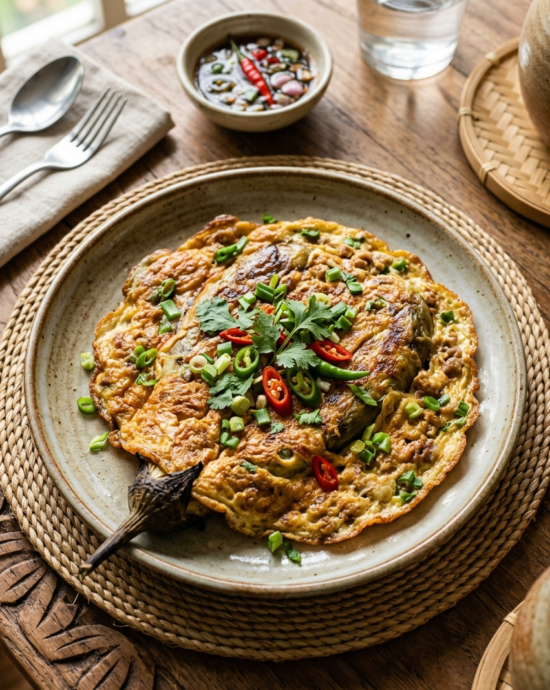
Carefully slide a wide spatula underneath the cooked first side of the tortang talong, supporting as much of the surface area as possible to prevent the egg crust from cracking or the eggplant from falling apart during the flip. Flip in one confident, smooth motion and cook the second side for 2–3 minutes until equally golden and set. The finished torta should have a uniform, golden-brown egg crust on both sides that encases the smoky, tender eggplant flesh. The stem should still be attached, making it easy to handle and visually distinctive on the plate. Remove from the pan and place on a plate lined with paper towels to drain excess oil. Repeat the process with the remaining eggplants, adding more oil to the pan as needed between each batch.
- Step 6: Plate and Serve
Transfer the finished tortang talong to individual serving plates or a communal platter, arranging them stem-side up for a clean, attractive presentation. Tortang talong is traditionally served with steamed white rice and is typically accompanied by a small dish of banana ketchup, a mixture of soy sauce and calamansi, or a simple vinegar-garlic dipping sauce. Some cooks drizzle a small amount of soy sauce directly over the torta at serving. For a complete breakfast or lunch spread, serve alongside a fresh tomato and onion salad lightly dressed with fish sauce and vinegar, whose acidity and freshness complement the smoky richness of the eggplant perfectly. Serve immediately while the egg crust is still crisp and the interior is warm.
- Calories:230 kcal12%
- Protein:12 g24%
- Carbohydrates:9 g3%
- Sugar:4 g4%
- Fat:16 g21%
- Energy:962 kJ12%
Table of Contents
What Is Tortang Talong?
Tortang talong is a beloved Filipino egg dish made by charring whole eggplants over an open flame, peeling them, flattening them, dipping them in beaten egg, and pan-frying until golden brown on both sides. The word ‘torta’ in Filipino refers to a pan-fried egg omelette or patty, and ‘talong’ is the Filipino word for eggplant — making tortang talong literally a fried eggplant omelet. It is one of the most approachable, economical, and widely eaten dishes across the Philippines, found on breakfast tables and lunch spreads from urban Manila apartments to rural barrio kitchens in equal measure. Despite its simplicity, it delivers a deeply satisfying combination of smoky, creamy, and savory flavors that earns it a permanent place among the most beloved staples of Filipino home cooking.
The technique of charring the eggplant directly over flame before cooking is the crucial technique that defines the dish. Unlike Western preparations where eggplant is typically peeled before cooking, tortang talong fully chars the skin to impart a deep, woody smokiness that permeates the entire eggplant. This technique mirrors similar approaches found in Middle Eastern baba ganoush and South Asian brinjal preparations, suggesting that the intuitive recognition of smoke as an eggplant flavor enhancer exists across multiple culinary traditions independently. In the Filipino version, the smoky roasted eggplant is then encased in egg and fried — transforming it from a vegetable preparation into a satisfying, protein-enriched main dish suitable for any meal of the day.
Tortang talong also exists in a more substantial version known as ‘tortang talong with giniling,’ where seasoned ground pork or beef is pressed into the flattened eggplant before the egg dip and frying, creating a hearty, fully satisfying dish that requires no other protein accompaniment. Across its many iterations, tortang talong remains a masterclass in Filipino resourcefulness: transforming humble, inexpensive ingredients into a deeply flavorful, nourishing dish through technique alone.
Ingredient Notes
- Eggplant (Talong): Choose long, slender Filipino eggplants — thinner and more tender than Italian varieties — for the best results. They char more evenly, peel more easily, and have fewer seeds than globe eggplants. Look for firm, glossy, uniformly dark purple skin with no soft spots or brown patches.
- Eggs: Fresh, large eggs at room temperature produce a fluffier, more even egg coating. Room temperature eggs beat more easily and coat more uniformly than cold eggs straight from the refrigerator. Use 1 egg per eggplant as a minimum.
- Cooking Oil: Use a neutral oil with a high smoke point such as vegetable, canola, or coconut oil. Avoid olive oil, which has too low a smoke point for this preparation and may impart an unwanted flavor.
- Salt and Pepper: Season the egg mixture generously — the eggplant itself is bland and the egg coating carries all the seasoning for the finished torta. Taste the egg mixture before dipping and adjust accordingly.
Ingredient Suggestions
- Ground Pork with Garlic and Onion: The classic ‘tortang talong with giniling’ version — press a thin layer of cooked, well-seasoned ground pork into the center of the flattened eggplant before dipping in egg for a heartier, all-in-one meal.
- Cherry Tomatoes and Onion Side Salad: A quick salad of halved cherry tomatoes, sliced red onion, fish sauce, and calamansi juice served alongside tortang talong creates a bright, acidic contrast that balances the rich egg and smoky eggplant beautifully.
- Cheese: A sprinkle of grated quick-melt or Eden cheese over the egg-coated eggplant just before the second side finishes cooking creates a gooey, savory layer that elevates the simple torta into something indulgent.
- Calamansi Soy Dipping Sauce: Mix soy sauce, calamansi juice, and minced garlic for a simple dipping sauce that pairs perfectly with the smoky eggplant and golden egg crust.
Helpful Tips & Pro Tips
- Char the eggplants thoroughly. The deeper the char on the skin, the more pronounced and complex the smoky flavor in the finished torta. Do not remove the eggplant from the flame until the skin is completely blackened — it should look entirely charred, not just browned in spots.
- Why is my tortang talong falling apart? The torta falls apart when the egg coating is too thin, the oil is not hot enough, or the eggplant is flipped too soon. Ensure the oil is properly preheated, build up the egg coating with an extra spoonful while frying, and wait until the underside is fully set before flipping.
- Work with a wide spatula. The broad, fan-like shape of the flattened eggplant requires a spatula with a large, flat blade for clean, confident flips without cracking the egg crust or losing the shape.
- Let the eggplant cool before peeling. Attempting to peel a just-charred, steaming eggplant is both difficult and uncomfortable. Allow 5–10 minutes of cooling time — the skin releases much more cleanly once slightly cooled.
How to Serve and Store
Serve tortang talong immediately after frying while the egg crust is at its crispest and the interior is warm and fragrant with smoke. It pairs naturally with steamed white rice and is traditionally eaten at breakfast or lunch. For dipping, offer banana ketchup, a calamansi-soy sauce mix, or plain vinegar seasoned with garlic. Leftover tortang talong stores in an airtight container in the refrigerator for up to 3 days. Reheat in a lightly oiled pan over medium heat for 2–3 minutes per side to restore the crispy egg crust — avoid microwaving, which makes the egg coating rubbery and the eggplant watery. Tortang talong does not freeze well due to the delicate egg and moisture content of the eggplant.
Substitutions
- Eggplant → Bitter Melon (Tortang Ampalaya): Thin slices of blanched bitter melon can be folded into the beaten egg and pan-fried as a close cousin of tortang talong with a distinctly different, more bitter flavor profile.
- Eggs → Flax Eggs (Vegan Option): For a vegan version, use flax eggs (1 tbsp ground flaxseed mixed with 3 tbsp water, rested 10 minutes) per regular egg. The coating will be less fluffy but will hold the eggplant together adequately.
- Ground Pork → Ground Chicken or Turkey: For a leaner meat filling, ground chicken breast or turkey breast seasoned with garlic, onion, and soy sauce makes an excellent, lower-fat alternative.
- Fish Sauce → Soy Sauce: For seasoning the egg mixture or meat filling, soy sauce substitutes fish sauce at a 1:1 ratio for a less fishy but equally salty and savory result.
- Vegetable Oil → Coconut Oil: Frying in refined coconut oil adds a subtle tropical richness that complements the smoky eggplant without overpowering it.
Suggested Recipes
- Pinakbet: A Ilocano vegetable stew featuring eggplant as one of the primary vegetables, showing talong in a very different slow-cooked, bagoong-seasoned context.
- Tortang Giniling: A Filipino ground meat omelette that uses the same basic egg-and-meat torta technique without the eggplant base — perfect for days when talong is not available.
- Ginisang Ampalaya with Egg: A stir-fried bitter melon and egg dish that uses a similar egg-forward approach to a different vegetable, equally beloved at the Filipino breakfast table.
- Sinangag (Garlic Fried Rice): The perfect companion grain for tortang talong at breakfast — crispy garlic-fried leftover rice that mirrors the smoky, savory flavors of the torta.
Frequently Asked Questions

Jeff Smith
"Cooking is the intersection of history, science, and emotion."
For me, the kitchen has always been a laboratory of culture. With a background deeply rooted in digital strategy and precision, I approach the culinary arts with the same rigor I apply to the digital landscape—analyzing flavors, perfecting techniques, and documenting the nuance that makes Filipino cuisine truly world-class.
Findme Recipe was born from a desire to bridge the gap between traditional heritage and the modern home cook. Whether it is mastering the perfect balance of acidity in a classic Adobo or simplifying complex regional dishes for everyday kitchens, my mission is to preserve our culinary identity through accessible, data-backed, and delicious content.
I am not just building a database; I am cultivating a community where every Filipino kitchen feels empowered, every ingredient is celebrated, and every family heirloom recipe finds a place to thrive.
Join me as we translate the soul of our islands into recipes for the next generation.